Privacy-First Employee Monitoring: A Global Compliance Playbook
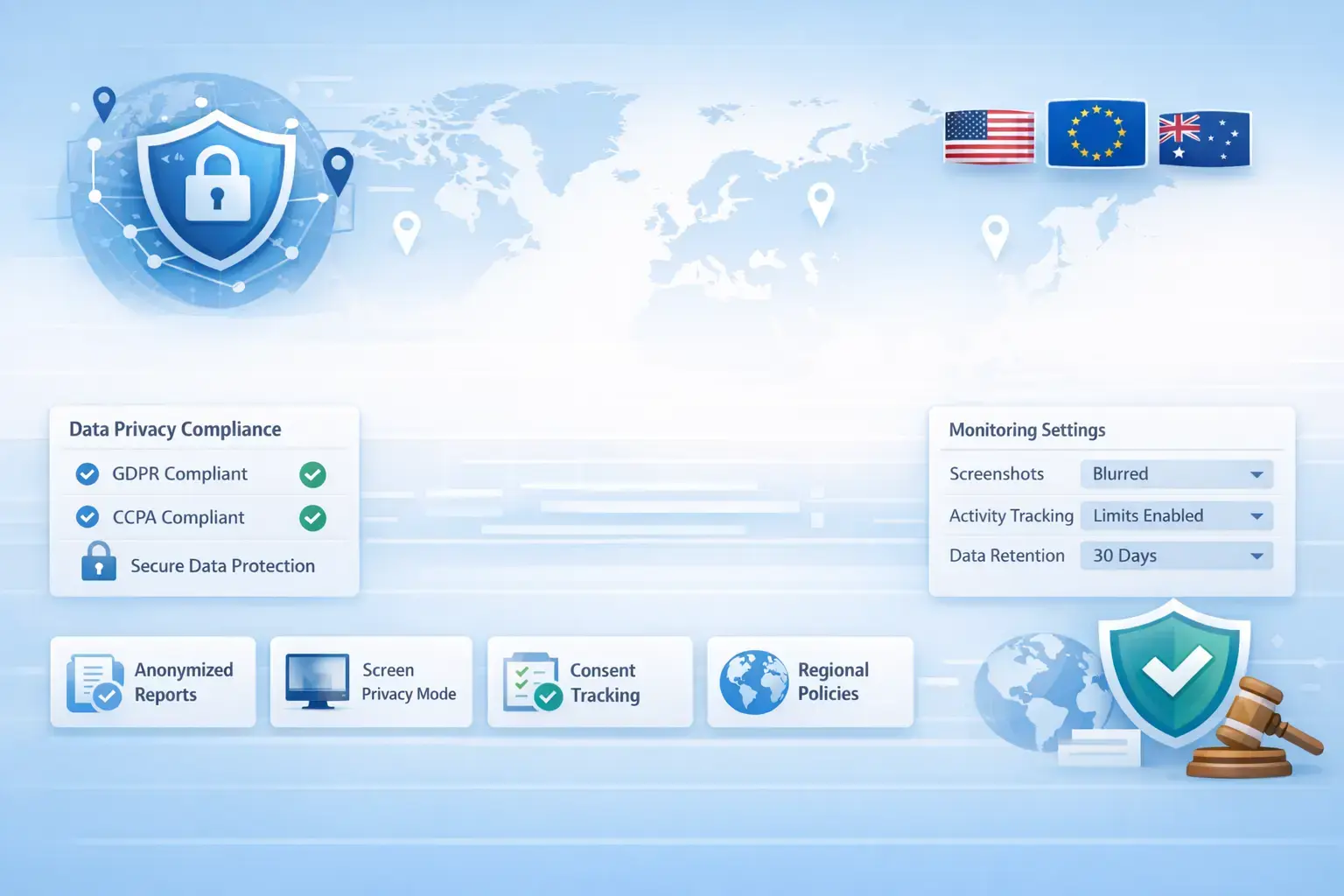
Employee monitoring is a hot topic in the workplace these days. Once framed as a reasonable way to secure systems and analyze productivity is described now in the media as “bossware”. This term means an invasive technology that undermines employee trust and crosses ethical and legal boundaries.
For those managing remote teams, or anyone working HR or IT, this creates a dilemma. While using monitoring tools helps add visibility, security, and insight into performance, many wonder about the legality behind using these tools.
For monitoring tools to be fully legal, they must be used carefully and in adherence with the privacy laws surrounding personal data. Simply launching a monitoring system without any thought can lead you to regulatory penalties, litigation, and harm to your business's reputation.
Those that approach it as a governance challenge, one that balances legitimate business interests with worker rights , are far better positioned to operate safely and sustainably. This article serves as a global compliance playbook for privacy-first employee monitoring.
This article will help translate regulatory expectations into practical guidance and show how different types of monitoring data are treated under major privacy regimes. It will also cover how regional laws diverge, and how monitoring programs can be configured to reduce risk while preserving trust.
Why Employee Activity Tracking Is Under Intensifying Scrutiny
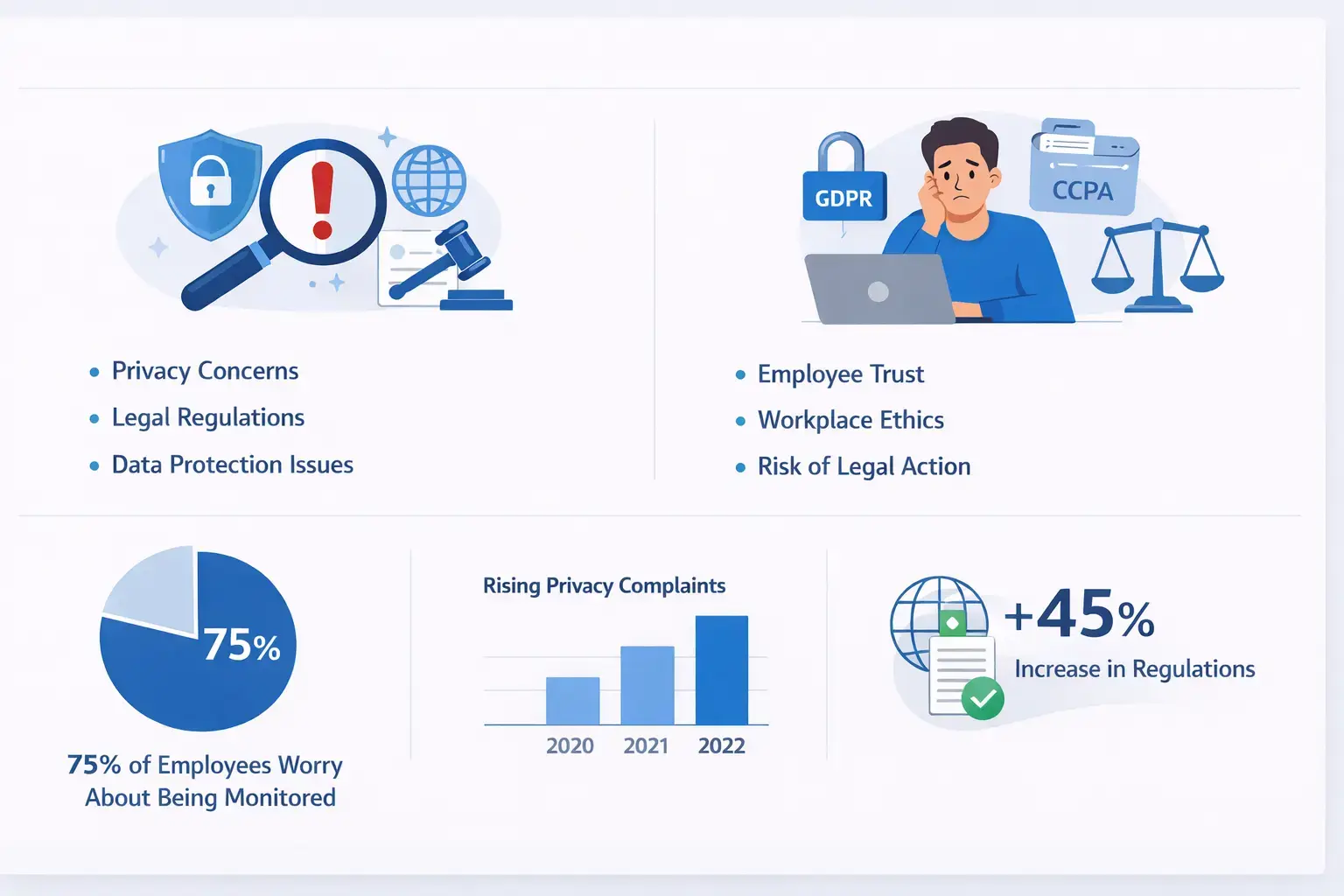
Regulatory and cultural climate dealing with employee monitoring has seen a shift in the past few years.. There are a few forces helping drive this change.
Privacy authorities have grown significantly more aggressive regarding data in the workplace. According to regulations like the EU's General Data Protection Regulation (GDPR), employees are clearly identified as a vulnerable group of data subjects.
Regulators are no longer convinced that monitoring is automatically justified merely because the devices or networks belong to the employer. Regulatory actions in Europe, Canada, and Australia are increasingly concentrating on the necessity, proportionality, and transparency of monitoring practices.
Secondly, the risk of litigation is increasing, especially in North America. Employers have encountered lawsuits concerning undisclosed surveillance, keystroke tracking, screenshot collection, location monitoring outside working hours, and audio recording.
These cases are often framed not only as privacy violations but also as labor, wage-and-hour, or discrimination claims, significantly raising financial exposure.
Third, reputational risk has become comparable to legal risk. Media reports frequently depict employee monitoring software as invasive oversight. Although a company’s actions may be legally permissible, ineffective communication or excessively intrusive data gathering can harm the employer's reputation, depress employee morale, and lead to higher turnover rates. In a competitive job market, trust has evolved into a strategic resource.
Together, these forces mean that organizations can no longer afford to treat employee monitoring as a background IT function. It must be governed deliberately, with privacy built into both policy and configuration.
Is Workplace Surveillance Legal? The Real Answer
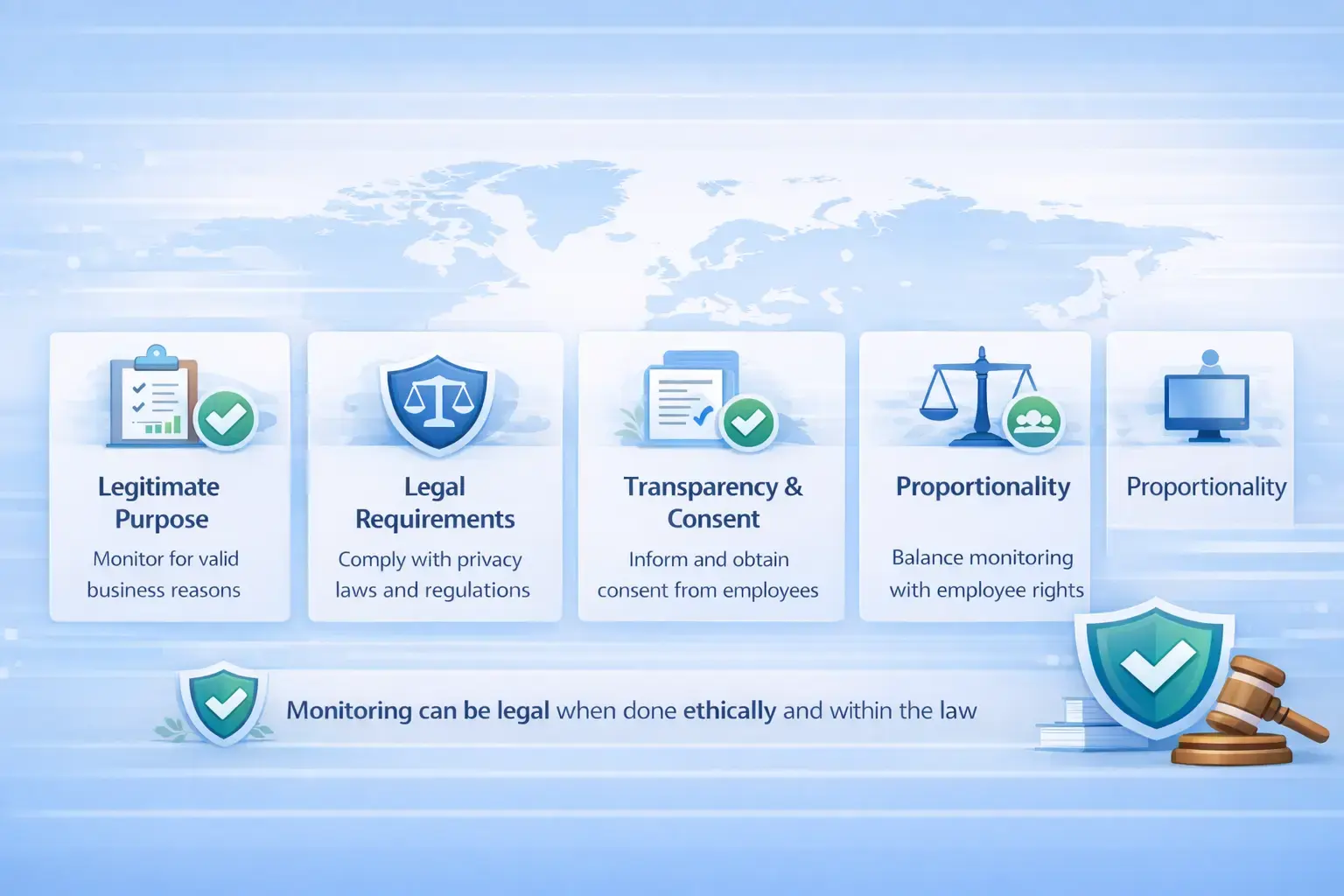
In most places, employee monitoring isn’t flatly prohibited, but it’s rarely a free-for-all either. The details vary by country, but the same themes tend to come up once you look past the specific statutes.
Monitoring is generally expected to serve a real business purpose, things like protecting systems, meeting regulatory obligations, or understanding how work is being done. Problems start when data is collected simply because a tool makes it easy, rather than because it’s actually needed.
How monitoring is communicated matters just as much as what’s collected. Employees are usually expected to be told in advance what’s being tracked, why it’s happening, and how the information will be used. Holding onto data indefinitely or giving broad access to people who don’t truly need it is another common source of trouble. In many jurisdictions, employees also have meaningful rights to see their data, challenge it, and in some cases ask for it to be deleted.
When monitoring causes issues, it’s often not because an organization chose to monitor at all. More often, things go wrong when too much data is gathered, kept for too long, or handled without much openness. At that point, what started as a reasonable business practice can quickly turn into a compliance headache.
Europe: GDPR and the Limits of Workplace Surveillance
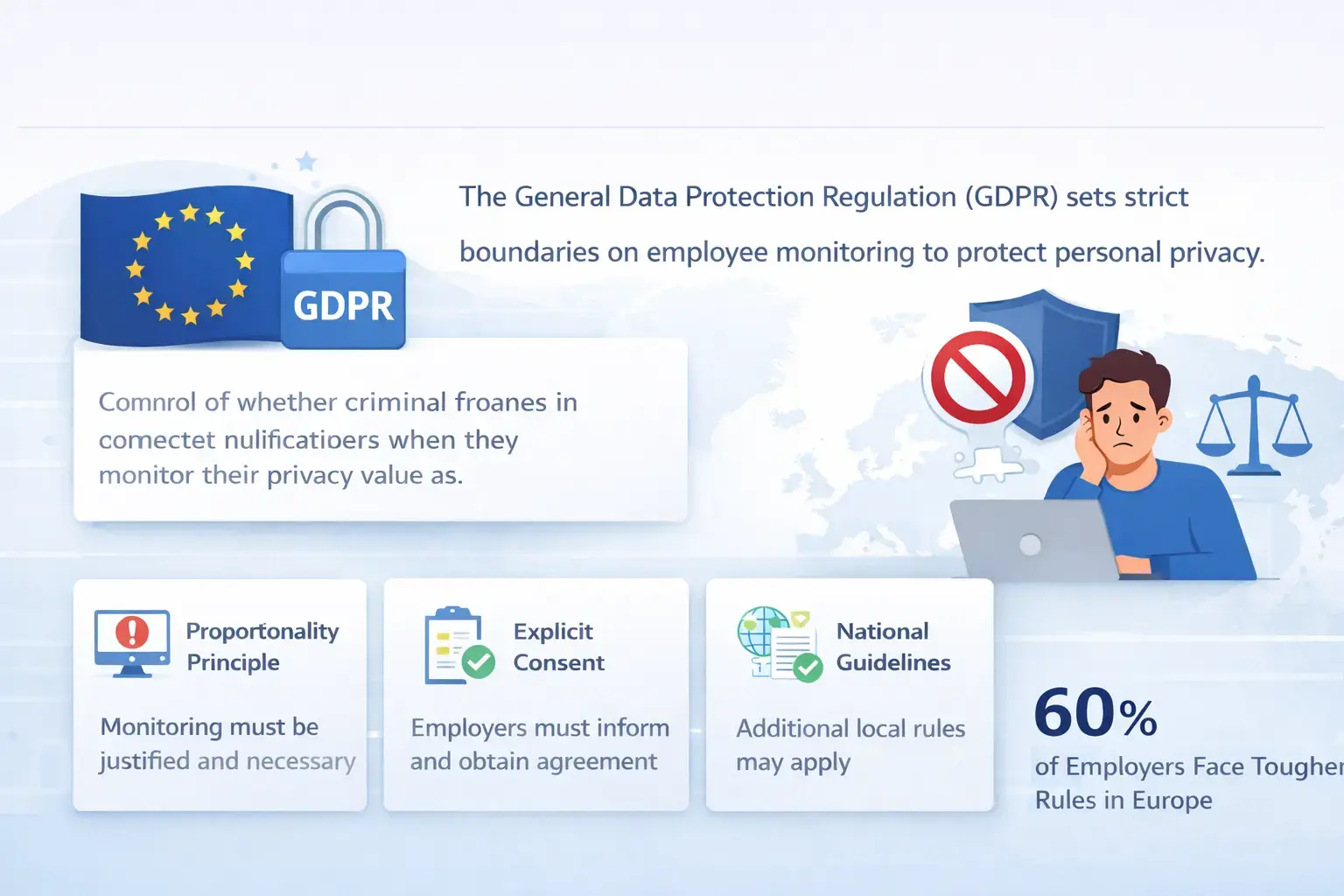
When it comes to employee monitoring, the EU is usually where organizations feel the most pressure to get things right. GDPR has effectively become the reference point for how monitoring is evaluated, even outside Europe.
From a regulatory perspective, employee monitoring is treated as inherently sensitive. The assumption is that it carries a high level of risk, which means employers need to be clear about why personal data is being processed in the first place. While consent might sound like the obvious answer, it rarely works in practice.
Because employers hold so much power over employees, regulators tend to view workplace consent as something people feel compelled to give rather than freely choose.
That’s why many companies fall back on “legitimate interests.” But relying on that basis isn’t a box-checking exercise. Organizations are expected to weigh their business needs against the privacy impact on employees and to show that monitoring is actually necessary. If the same outcome could reasonably be achieved with less intrusive data, regulators will usually expect that route to be taken.
In many cases, this analysis has to be written down formally. Ongoing productivity tracking, behavioral analytics, or any kind of systematic monitoring often triggers the need for a Data Protection Impact Assessment. Going through a DPIA forces teams to slow down and spell out what data is being collected, how it will be used, where the risks sit, and what safeguards are meant to keep those risks in check.
Proportionality runs through all of this. High-level trends or anonymized usage patterns are easier to defend than constant observation of individual behavior.
Practices like keystroke logging, frequent screenshots, or real-time scoring of employees tend to attract far more scrutiny, and regulators have taken action against them in the past. Audio recording or webcam monitoring sits even further out on the edge and is typically hard to justify outside very narrow, security-driven scenarios.
One area where there’s little room for interpretation is transparency. Employees need to understand what monitoring is in place, why it exists, how long data is kept, and what rights they have. Secret monitoring is allowed only in rare situations, such as investigating serious wrongdoing, and even then it’s expected to be temporary and tightly controlled.
The EU AI Act and Algorithmic Management
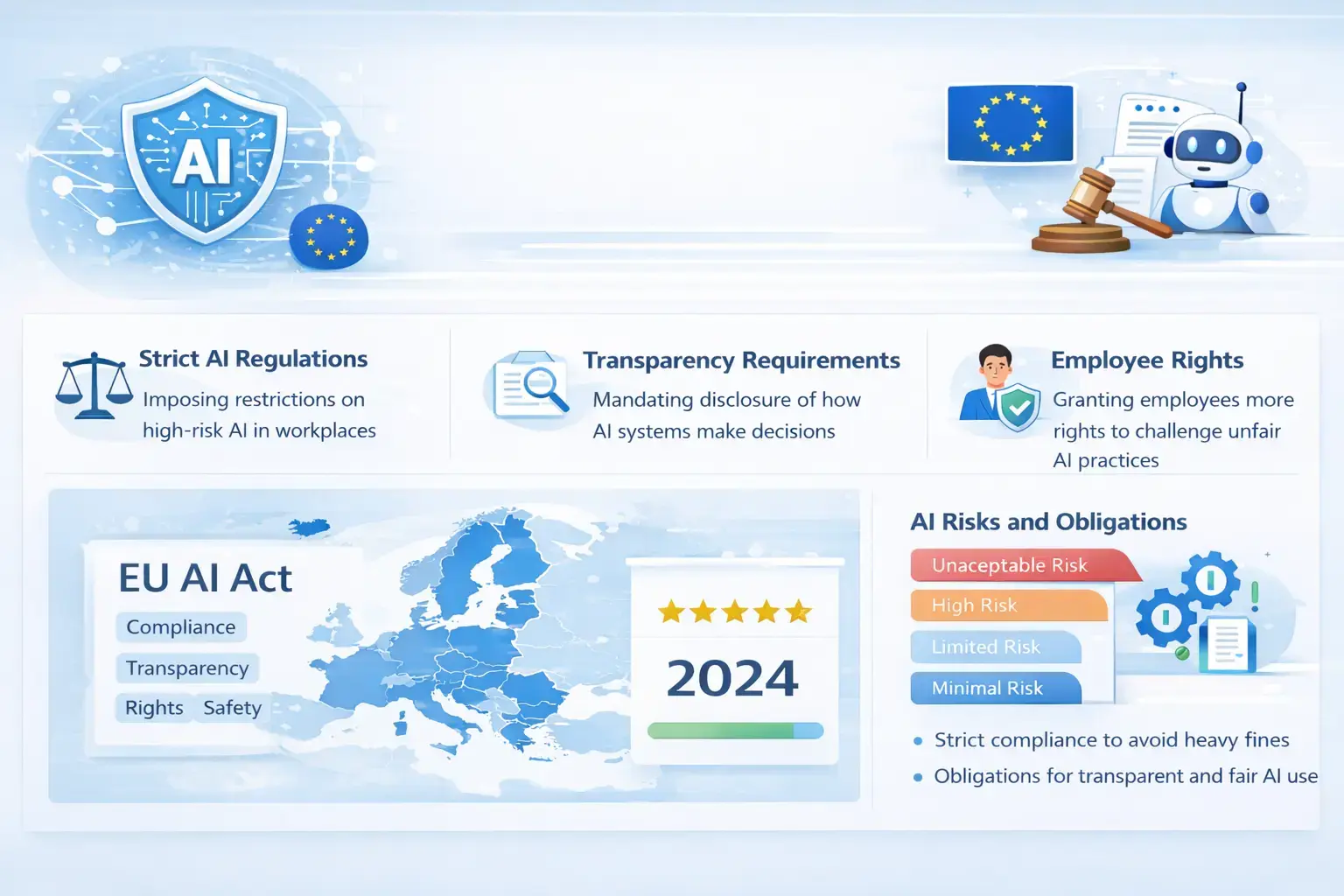
The EU AI Act adds another layer of complexity to monitoring. Most monitoring tools use algorithms to help analyze behavior and productivity. These algorithms are also used to flag any anomalies that may pop up. It's not uncommon for these systems to be used in performance evaluations, promotions, and even deciding whether disciplinary action is appropriate. Using them in this way puts them into the category of high-risk AI systems.
This raises the stakes for employers as automated scores should not be treated as factual without human oversight. There must be a solid review, challenge, and correction process for when the algorithms get it wrong. It will still be a while before the AI Act is fully implemented, so any business using monitoring today should get ready for these requirements to take effect, and design their systems accordingly.
The United Kingdom: Fairness and Necessity
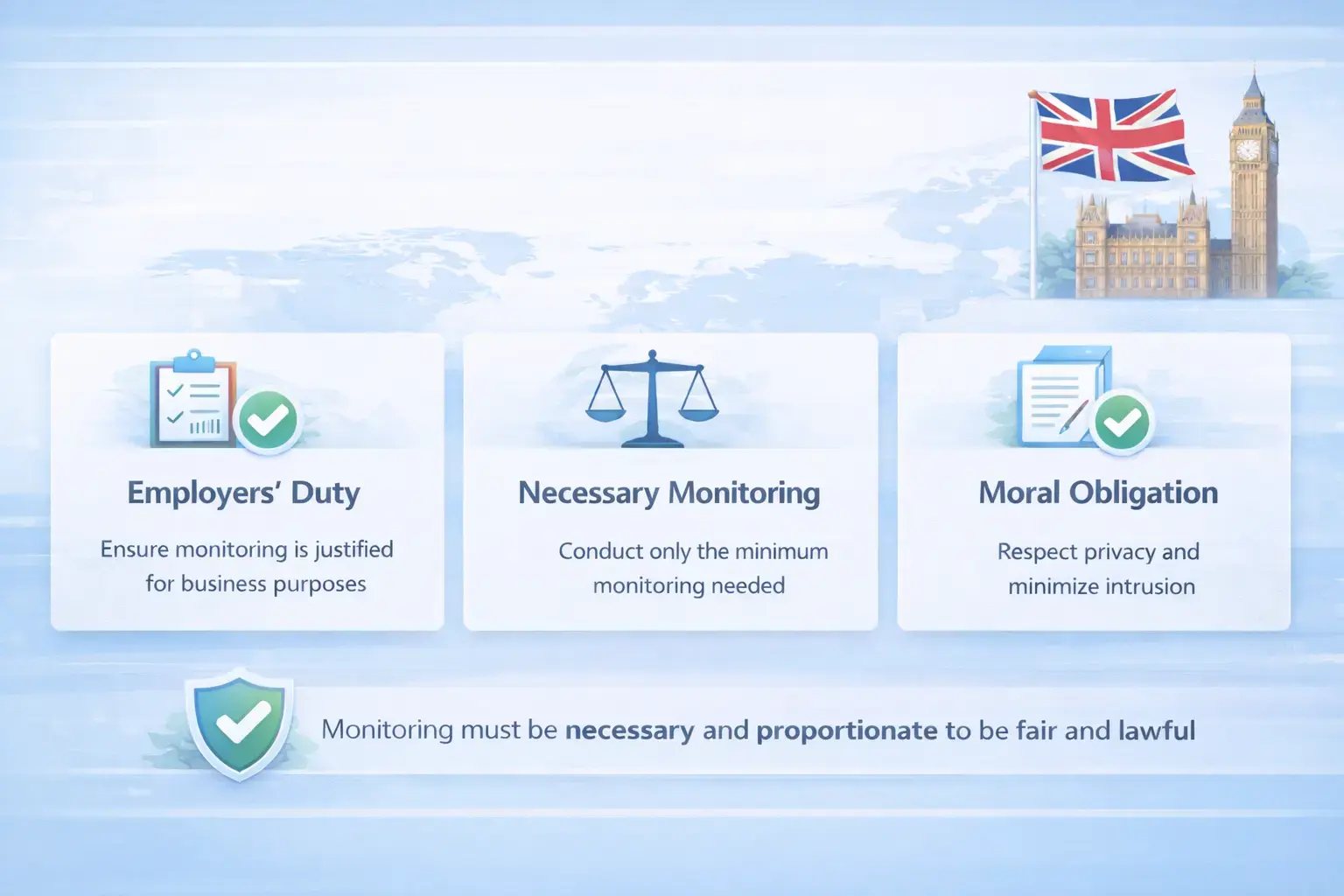
In the UK, employee monitoring is governed by the UK GDPR and guidance from the Information Commissioner’s Office (ICO). The ICO’s Employment Practices Code emphasizes fairness, necessity, and proportionality. Monitoring should address a specific, articulated problem, not serve as a general productivity panopticon.
The ICO has consistently warned against technology-led monitoring that lacks a clear business case. Employers are expected to consider less intrusive alternatives and to involve employees or their representatives when introducing monitoring programs. While covert monitoring is not entirely prohibited, it is heavily restricted and generally limited to serious misconduct investigations.
The United States: A Patchwork of Laws
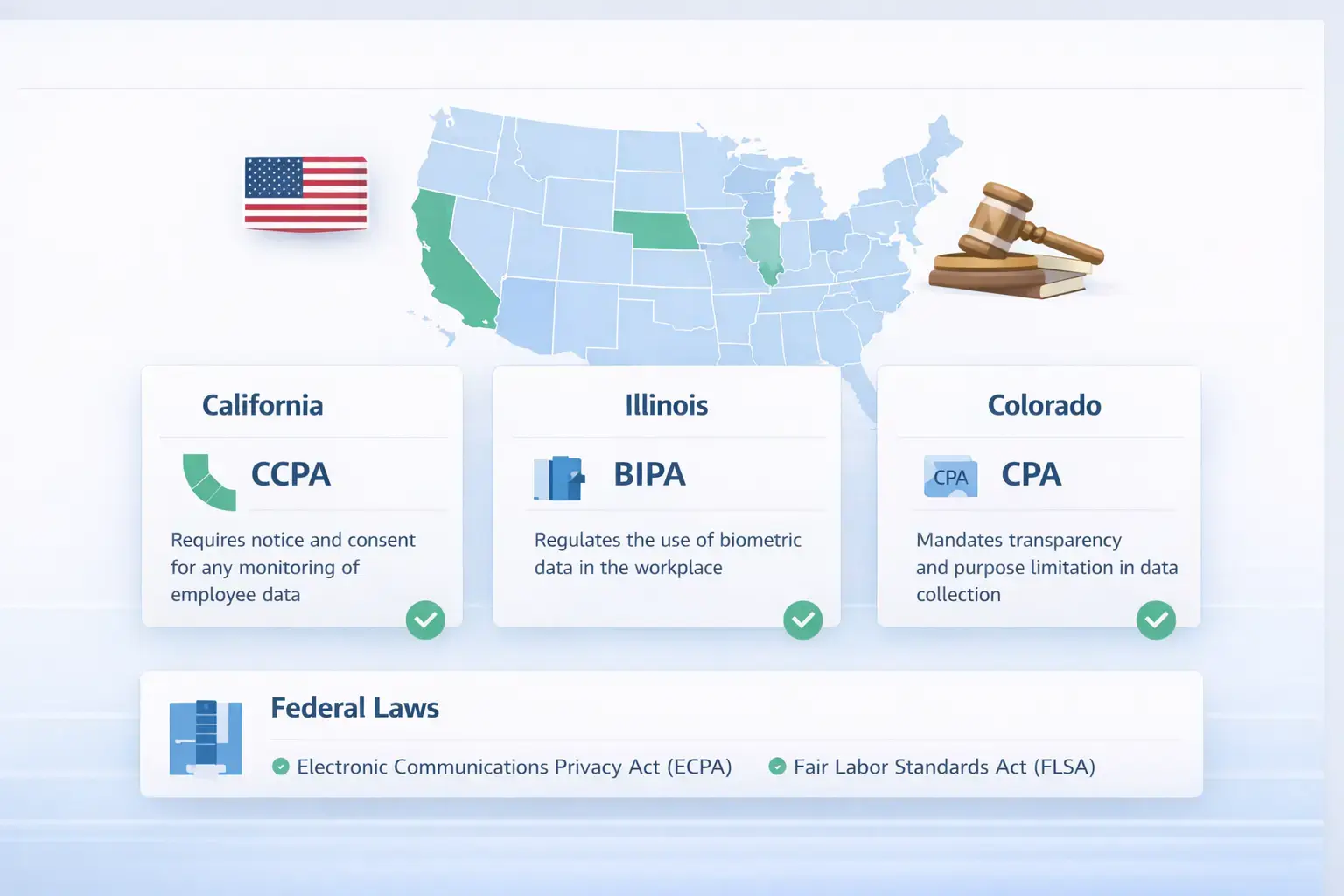
In the United States, there is no single federal employee privacy law equivalent to GDPR. Instead, legality depends on a combination of federal statutes, state laws, and common-law principles.
At the federal level, employers generally have broad rights to monitor company systems, particularly when devices and networks are employer-owned. However, federal wiretapping laws make audio recording especially risky without explicit consent.
State laws significantly complicate the picture. In California, the CCPA and its amendment, the CPRA, require employers to provide notice at collection, disclose purposes, and honor access and deletion rights. New York mandates written notice of electronic monitoring and employee acknowledgment. Other states impose consent requirements for audio or video recording or recognize stronger privacy expectations.
The practical takeaway for US employers is that transparency is essential. While covert monitoring may sometimes be technically legal, it is increasingly indefensible from both a compliance and reputational standpoint.
Canada and Australia: Reasonableness and Notice
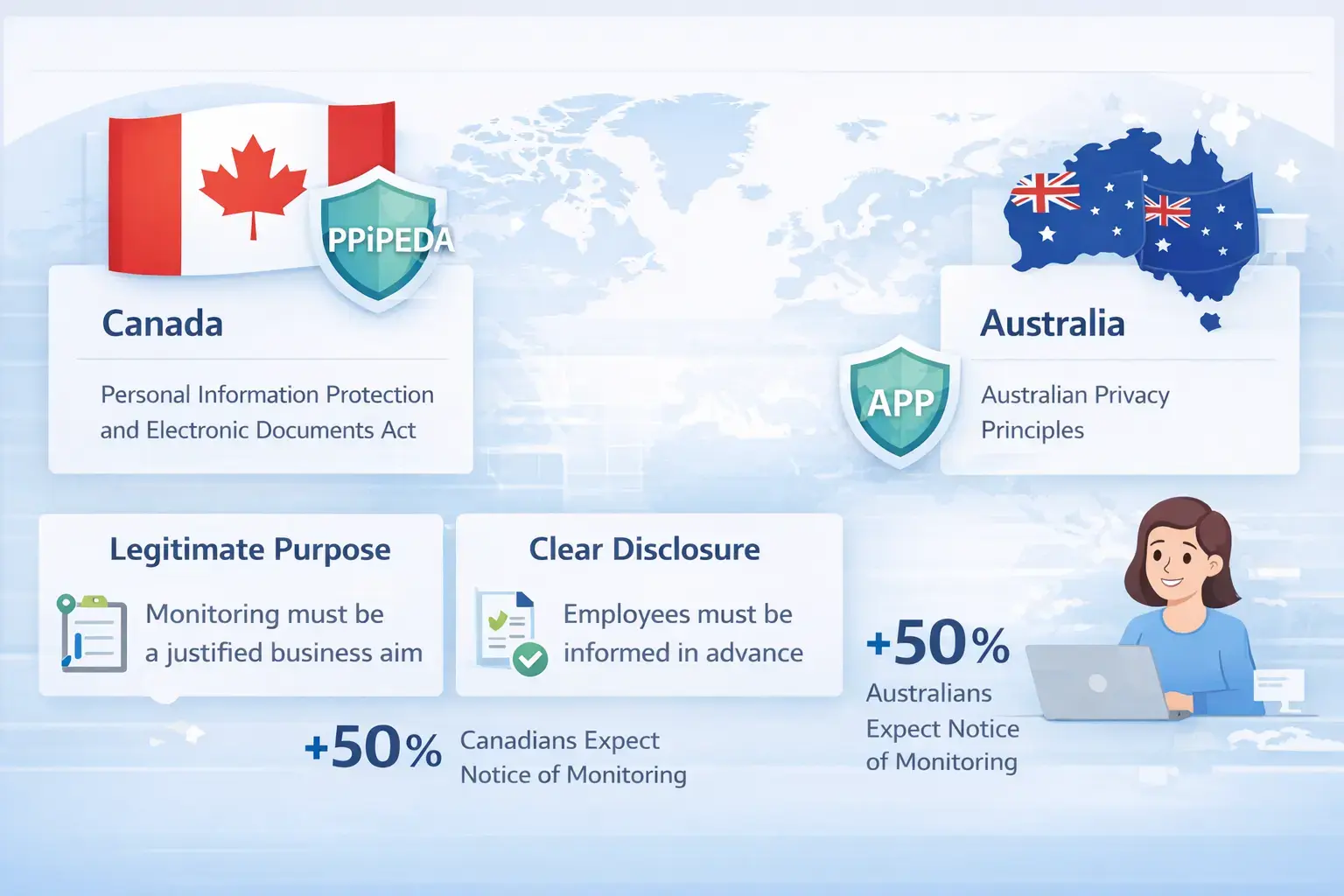
In Canada, PIPEDA governs employee monitoring in the private sector. The law focuses on reasonableness. Employers must demonstrate that monitoring is appropriate for the stated purpose and that employees are informed. Canadian regulators have criticized intrusive practices such as keystroke logging and constant screenshot capture, particularly when used for productivity measurement rather than security.
Australia’s Workplace Surveillance Acts, which vary by state, typically require advance written notice of monitoring and clear disclosure of its nature and purpose. Covert surveillance is generally restricted and often requires judicial authorization.
Across both jurisdictions, the pattern mirrors Europe: monitoring is allowed, but only when carefully limited and transparently communicated.
Not All Monitoring Data Is Equal
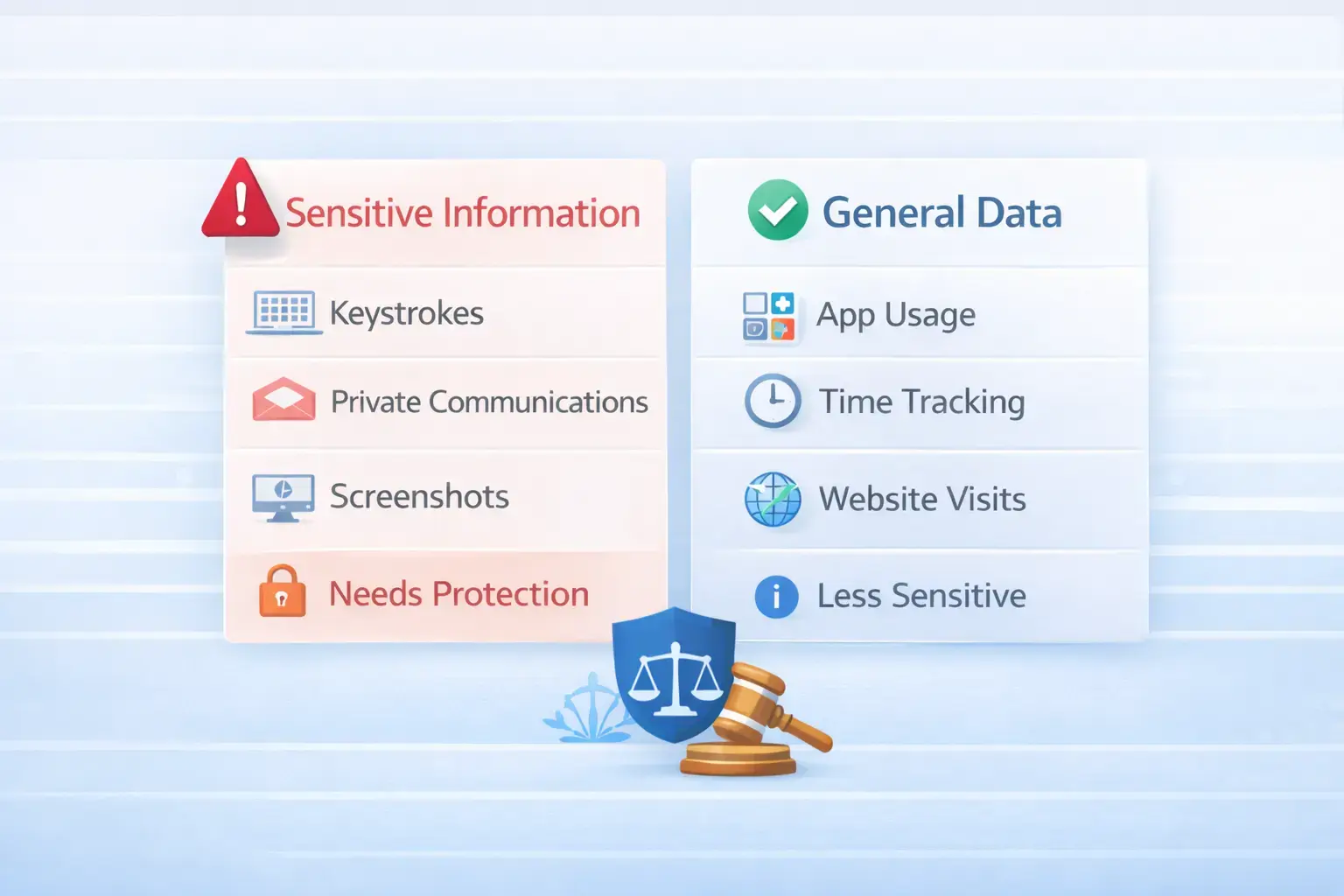
One of the most common compliance mistakes is treating all monitoring data as equivalent. Regulators don’t usually look at monitoring tools in the abstract. What they focus on is how invasive the data actually is and what it reveals about an individual.
Broad, aggregated reporting, things like team-level trends or workload patterns, tends to raise fewer concerns, especially when it’s difficult to tie the data back to a specific person. Once you move into tracking individual behavior, the risk starts to climb.
Logging which applications or websites someone uses during work hours, for example, is often acceptable, but only if employees are clearly informed and the data has a defined purpose.
Screenshots change the equation quickly. Taken too often, or without tight controls, they can capture personal messages, sensitive information, or activity that has nothing to do with work. Tools like keystroke logging, location tracking, or collecting audio or biometric data sit at the far end of the spectrum and are among the hardest to defend from a privacy standpoint.
For most organizations, the safest starting point isn’t asking how much data they can collect. It’s deciding where monitoring stops.
Privacy-First Monitoring in Practice
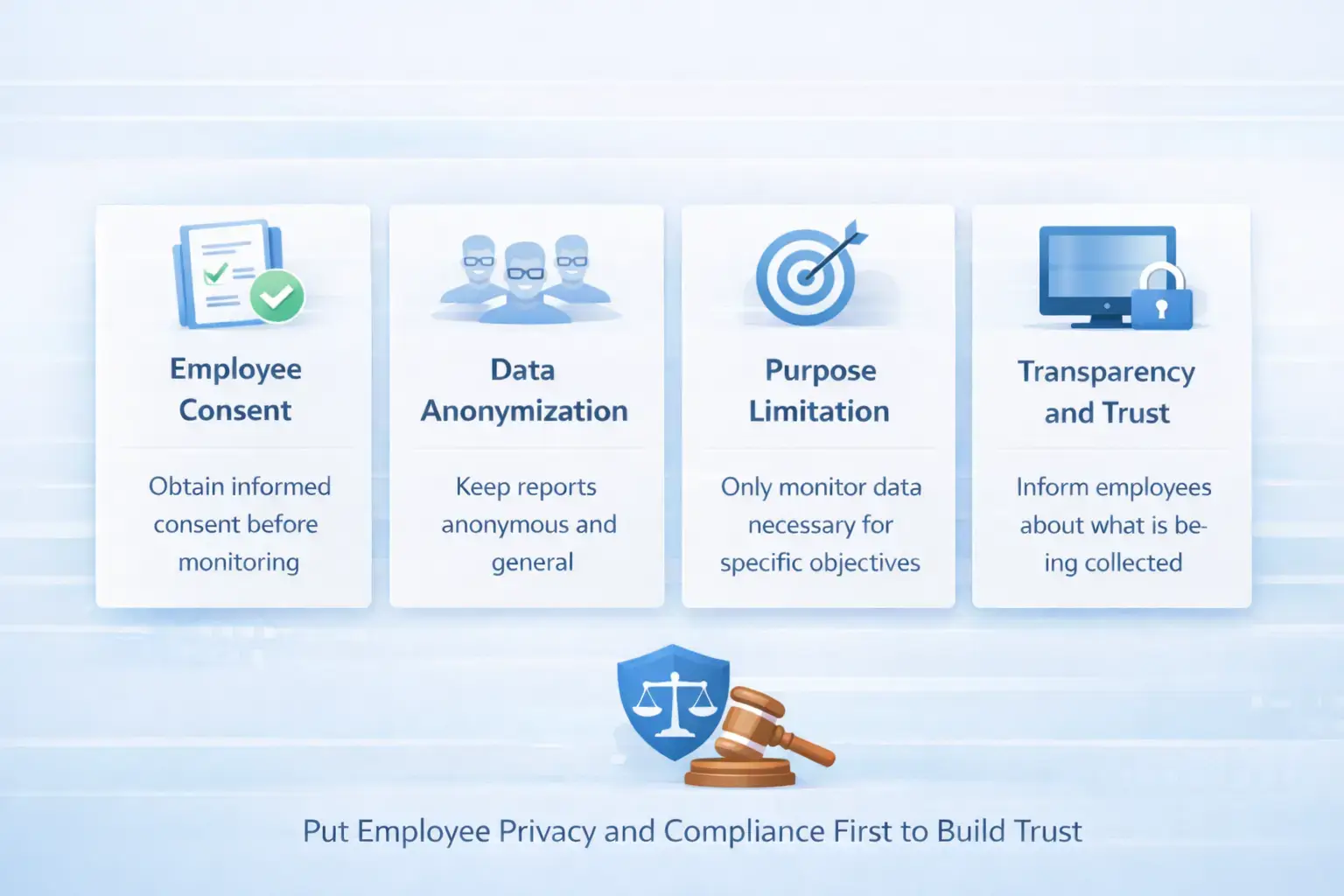
Taking a privacy-first approach to monitoring doesn’t mean flying blind. It means being deliberate about how much visibility is actually needed in different situations.
For many teams, that starts with data that never points to a specific person at all. Aggregate reporting can be enough to understand staffing needs, spot capacity issues, or flag security anomalies without turning monitoring into something personal.
There are cases where more detail is useful, but even then, it’s usually possible to limit exposure. Some organizations rely on anonymized or pseudonymized data when they’re trying to improve a process or support coaching, and put clear guardrails around when, or if, identities can be revealed.
Direct, named monitoring is a different category altogether. Most companies reserve it for narrow situations like security incidents or formal investigations, and even then, access is documented and time-bound rather than open-ended.
The common thread is restraint. Monitoring works best when it’s treated as a specific response to a specific need, not as something that quietly expands by default.
Transparency, Notice, and Trust
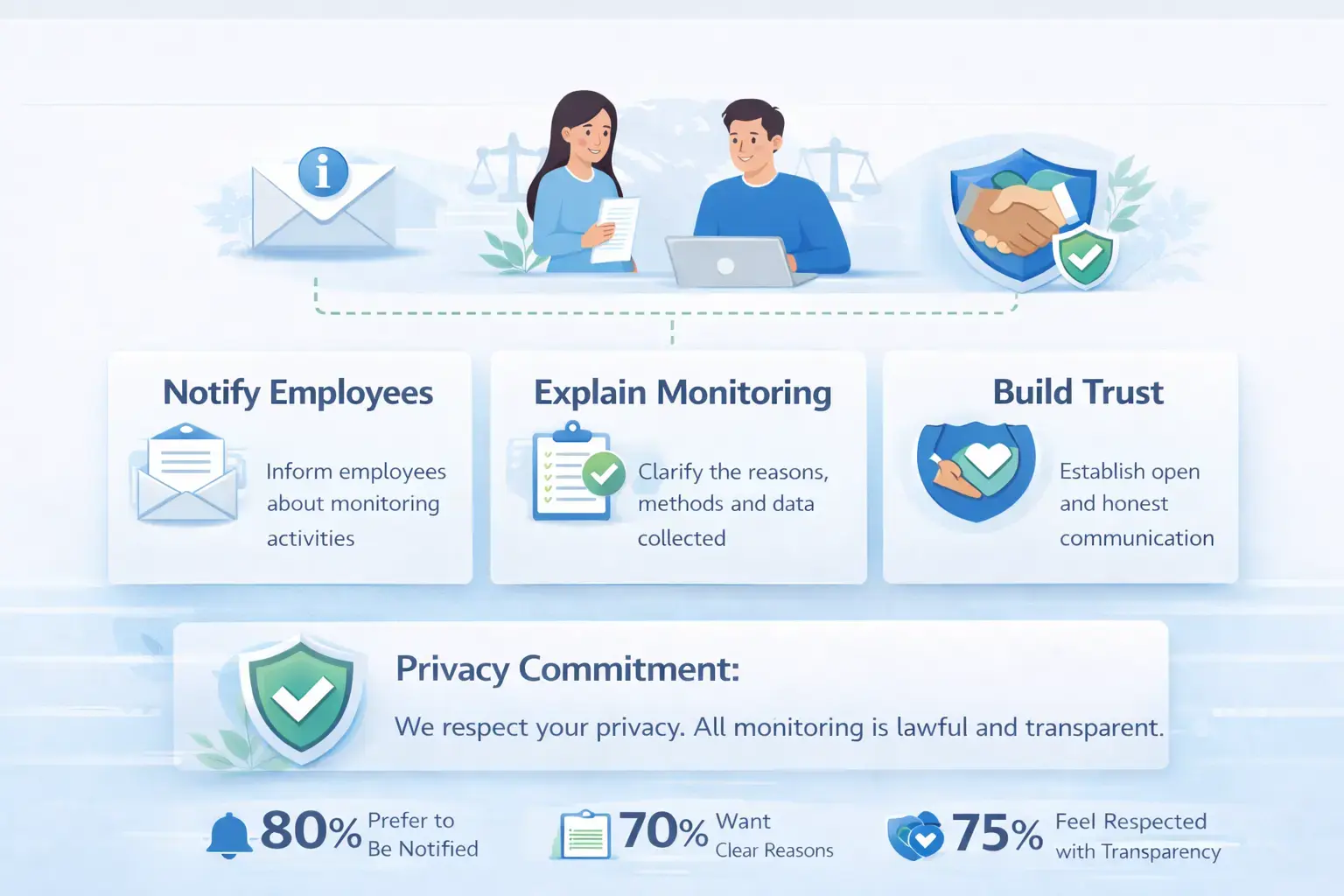
No matter where a team is based, a lack of transparency is usually where monitoring programs run into trouble. When people don’t know what’s being tracked, or start guessing, they tend to assume the worst.
Clear communication helps prevent that. Employees should have a plain-language understanding of what monitoring exists, what it’s meant to achieve, and where the lines are drawn. Policies and notices matter for legal reasons, but they also serve a more practical purpose: they reduce uncertainty and set a shared baseline for what’s acceptable.
The most effective notices go beyond legal boilerplate. They explain why monitoring is in place, call out what data is deliberately off-limits, give a sense of how long information is kept, and point employees to their rights. When monitoring is presented as a way to protect systems or improve how work gets done, rather than as a way to watch individuals, it’s usually met with far less resistance.
Governance, Auditing, and Ongoing Compliance
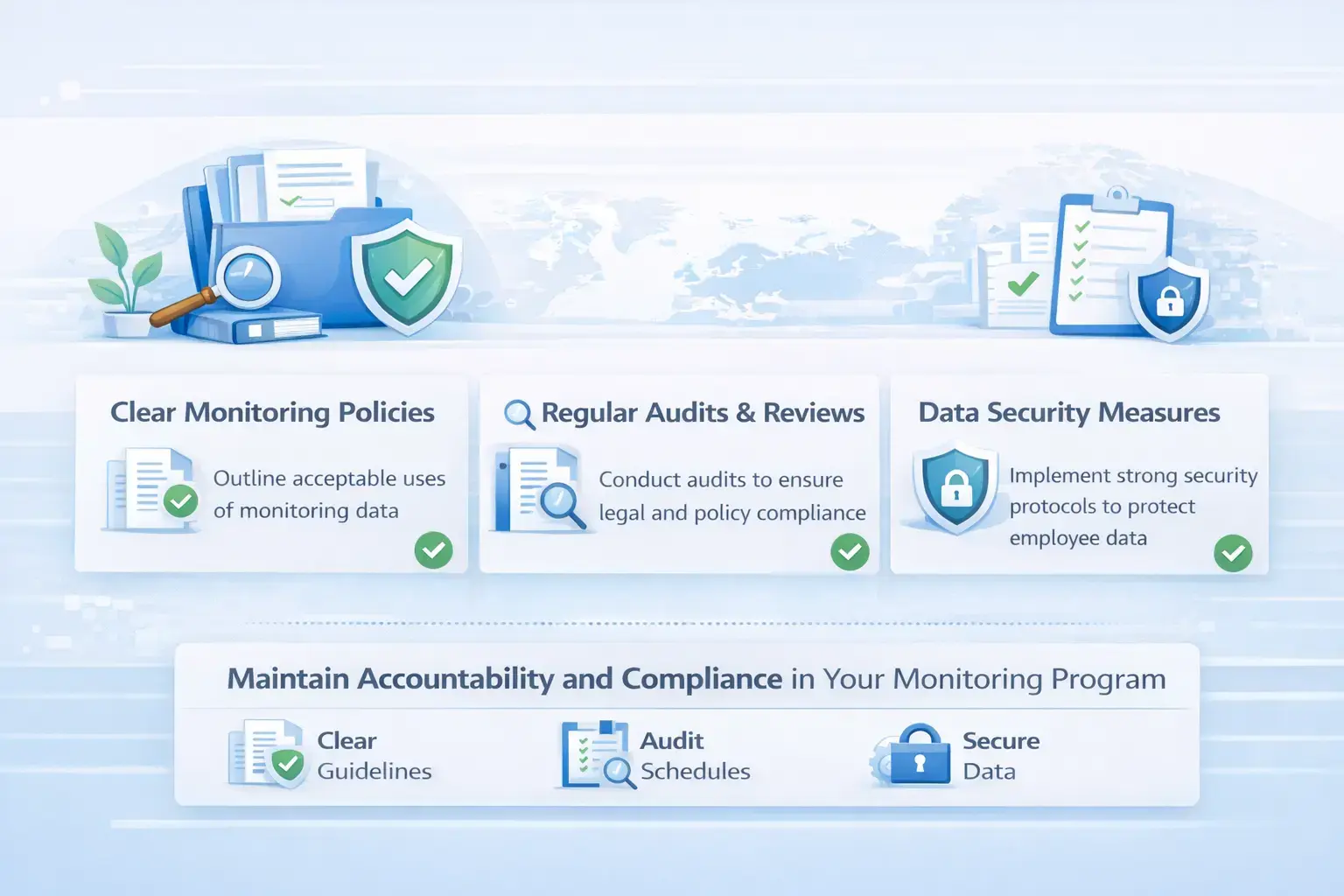
Compliance does not end at deployment. Monitoring programs should be reviewed regularly to ensure they remain necessary and proportionate. Access to monitoring data should be logged and audited. Retention periods should be enforced technically, not just described in policy. HR and IT teams should be trained to handle employee data requests and challenges.
This ongoing governance is increasingly expected by regulators and can be decisive in the event of an investigation.
Cross-Border Remote Work and Monitoring Compliance in Distributed Teams
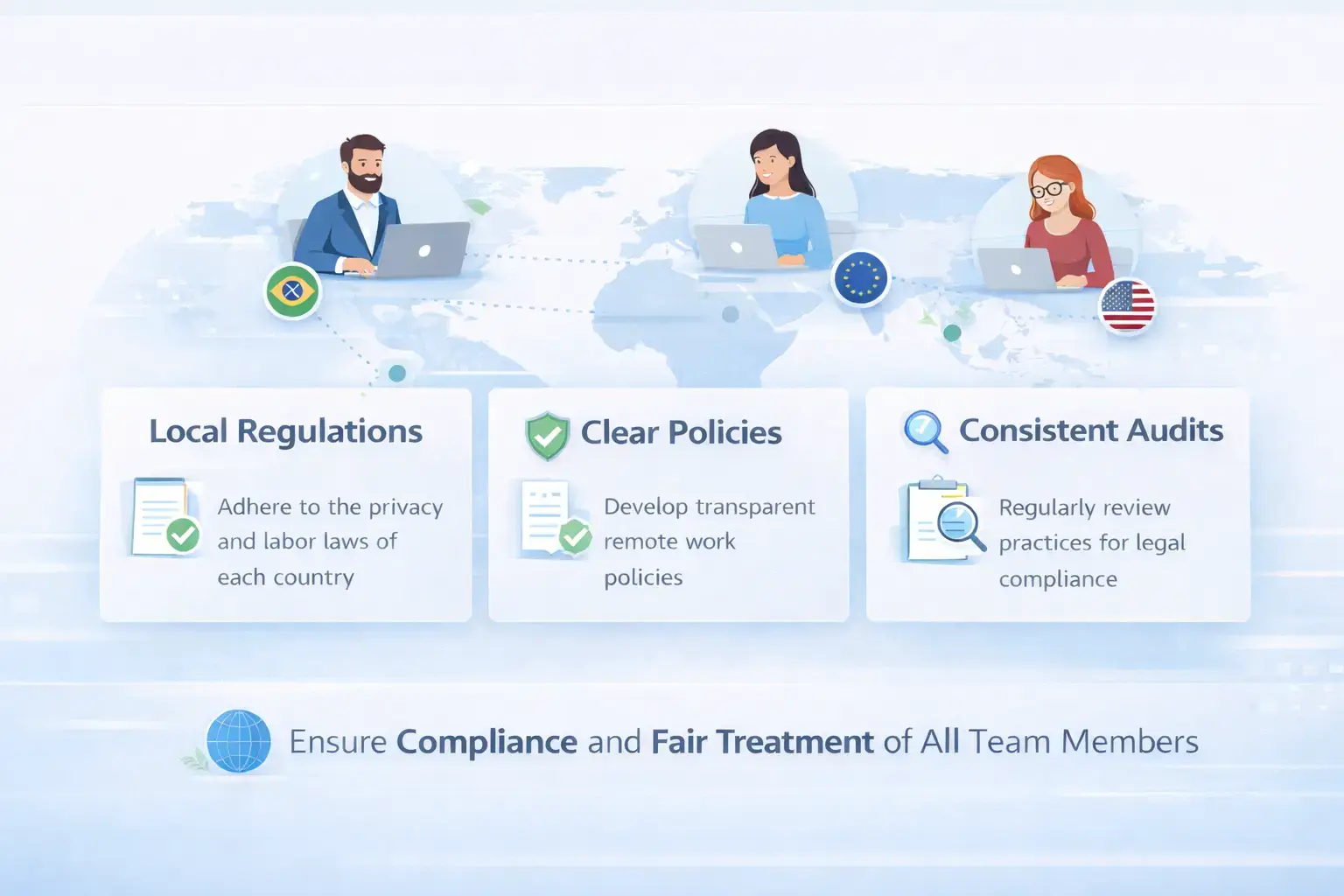
Employee monitoring gets much harder once teams cross borders. Distributed organizations often employ people in multiple countries, each with its own rules around privacy, labor rights, and surveillance.
Something that’s perfectly fine in one country can cause real problems in another. This becomes an issue fast when companies try to deploy the same employee monitoring tools everywhere without adjusting for local rules.
A mistake teams often make is assuming the company’s headquarters sets the legal standard. In reality, regulators usually care far more about where the employee is actually working. If someone is based in Germany, for instance, GDPR applies, even if the same tool raises no concerns for colleagues in the U.S. That’s where things start to get tricky.
Using the most permissive standard everywhere can expose the organization to compliance failures, while applying the strictest standard globally can remove features teams rely on. Many companies navigate this by configuring monitoring tools differently by region, aligning them with local legal thresholds and cultural expectations rather than forcing uniformity.
Data access across borders introduces another layer of risk. Monitoring data collected in the EU but viewed by managers or systems outside the EU may count as an international data transfer under GDPR. Without safeguards like Standard Contractual Clauses and documented transfer impact assessments, even routine actions, such as opening a dashboard, can trigger compliance issues.
This is easy to overlook in remote-first environments, where data access feels purely operational and location fades into the background. But regulators don’t see it that way.
Working hours add further complexity. Tracking activity or location outside agreed working hours can unintentionally capture personal behavior, especially when employees work flexible schedules across time zones. Privacy-first programs increasingly limit data collection to defined working hours and pause monitoring outside those windows. Doing so helps respect local labor norms while reducing the risk of collecting more data than is necessary, or lawful.
Ultimately, managing employee monitoring across borders isn’t just a legal exercise. It requires adaptable technology, clear internal ownership, and ongoing coordination between HR, legal, and IT. Organizations that approach remote monitoring as a global compliance challenge, rather than a simple IT rollout, are far better positioned to scale responsibly without undermining trust.
Aligning Workplace Surveillance With Ethical Management and Workplace Culture
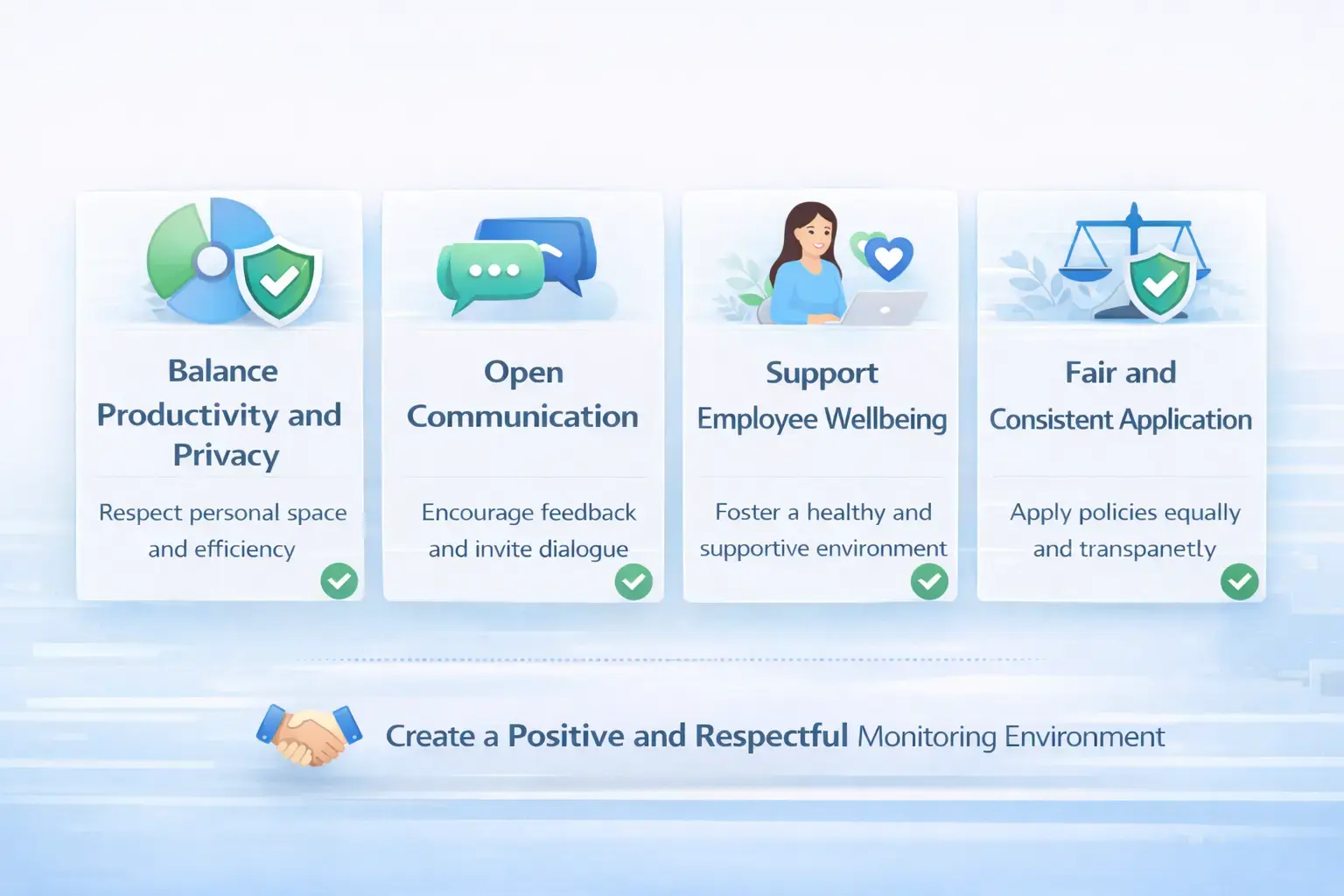
Just because employee monitoring is legal doesn’t mean it always sits comfortably. Many teams struggle with where to draw the line, especially in remote environments where almost all work runs through software and the boundary between work time and personal time is already blurry.
A lot of this comes down to why monitoring is introduced in the first place. Tools rolled out to deal with security gaps, understand workload issues, or fix broken processes tend to be received very differently from tools that feel like they exist to watch people closely or keep score. Employees usually sense that distinction quickly, and once suspicion sets in, it’s hard to undo.
When monitoring starts to feel constant, the behavior it produces often isn’t what leaders expect. People pull back, play it safe, or shift their energy toward whatever metric seems safest to optimize. In some cases, teams simply learn how to work around the system. Whatever visibility is gained in the short term can be offset by lower trust and weaker engagement.
The setups that hold up best over time usually involve more than one voice. Instead of treating monitoring as a management-only decision, organizations that involve HR, legal, IT, and sometimes employees themselves tend to make clearer choices about what data is collected and how it’s used.
Drawing firm lines around what can inform coaching versus what should never be used for discipline matters more than most teams expect. Day-to-day culture is shaped by how explicit those choices are. When people know what’s monitored, what isn’t, and when monitoring applies, anxiety drops.
Saying out loud that personal messages, webcams, or audio aren’t touched can be just as important as describing what is tracked. Some teams even give employees access to their own data or let them opt into certain features, which helps make monitoring feel less one-sided and more accountable.
Where Controlio Fits
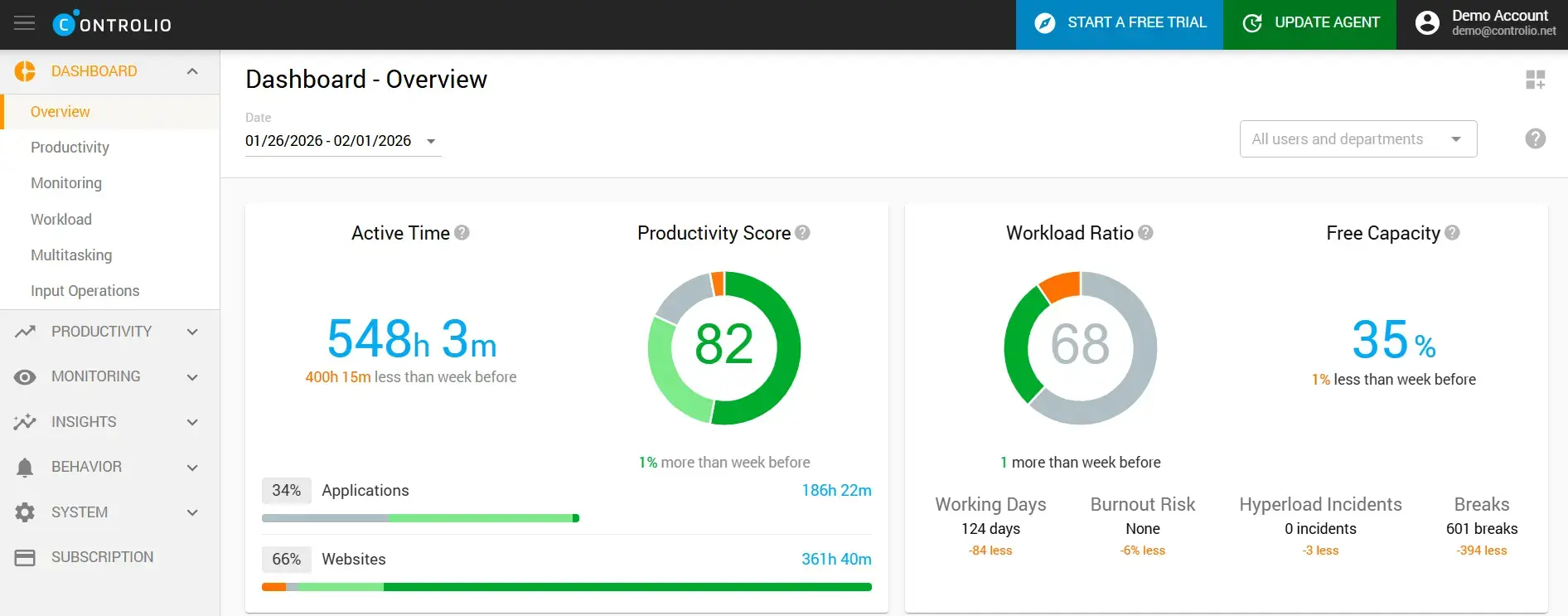
Contemporary monitoring tools can maintain visibility without sacrificing privacy. The systems that tend to endure the longest are often those created with constraints considered from the beginning.
Controlio was developed based on that concept. Instead of promoting a universal strategy, it provides organizations with effective methods to synchronize monitoring with the privacy regulations they are already managing in various regions.
Teams can manage visibility through role-based access, modify data collection levels, obscure or restrict screenshots, and implement varied retention policies based on location. Comprehensive audit logs assist HR, IT, and legal teams in comprehending how monitoring is genuinely utilized, rather than merely how it is set up.
The objective isn't to gather additional data. It's improved management. Organizations can implement monitoring by restricting data collection, enhancing access controls, and making activities traceable, thus avoiding a black box scenario or prolonged compliance risks.
In addition to other privacy and compliance features like GDPR mode and access control policies, Controlio is sure to have a monitoring solution tailored for your business.
Final Thoughts
Employee monitoring, when done correctly, can be a powerful tool for managing employees, expectations, and productivity. Problems can pop up when the monitoring becomes excessive or poorly implemented. Regulations around employee monitoring are tightening up, so turning towards a more privacy focused method of monitoring is important for long term success.