Moonlighting, Overemployment & Shadow Work: Assessing Impact, Setting Fair Policies & Using Data Signals Responsibly
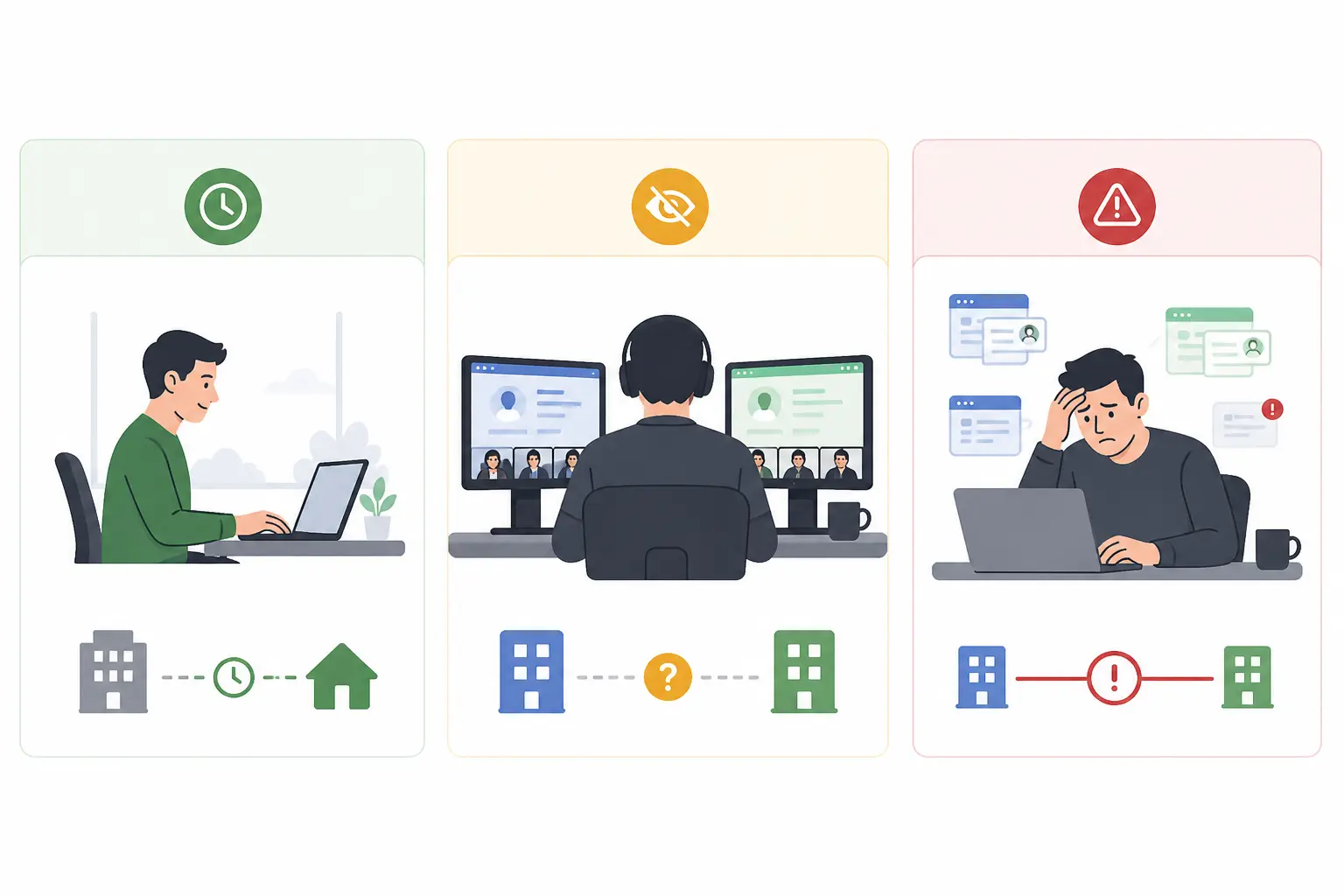
Something shifted when distributed work became the default. A workplace problem that used to surface maybe once a year — an employee quietly holding a second job, running a side business on company time, or doing "shadow work" that competed with their primary employer — started showing up everywhere. Remote work made it structurally easier. Economic pressure made it more tempting. And most HR teams were left holding policies written for a world where people had to physically be somewhere to be working.
Two bad responses are already common. Organizations that ignore the problem find out what that costs eventually — productivity erosion that's hard to trace until it isn't, conflict of interest exposure nobody planned for, data leakage that can't be walked back. The organizations that overreact tend to trade one problem for several worse ones. A monitoring apparatus that goes too far burns trust at scale, creates legal exposure from privacy overreach, and tends to drive exactly the kind of attrition nobody budgeted for. Neither direction gets anyone where they want to go, which is why this guide takes a different approach entirely.
Remote work ethics have become a defining challenge for distributed organizations. What was once managed through physical presence and shared office norms now requires deliberate policy and behavioral signals. Work from home ethics — the unwritten but consequential expectations around availability, focus, and undivided commitment during paid hours — are harder to enforce and easier to violate than anything that existed in a traditional office. This guide treats that challenge as a governance problem, not a moral one. The goal isn't to pass judgment on what employees do with their own time. Policies written for physical offices mostly don't work for distributed teams. That's the gap this guide addresses.
Where the Terms Diverge
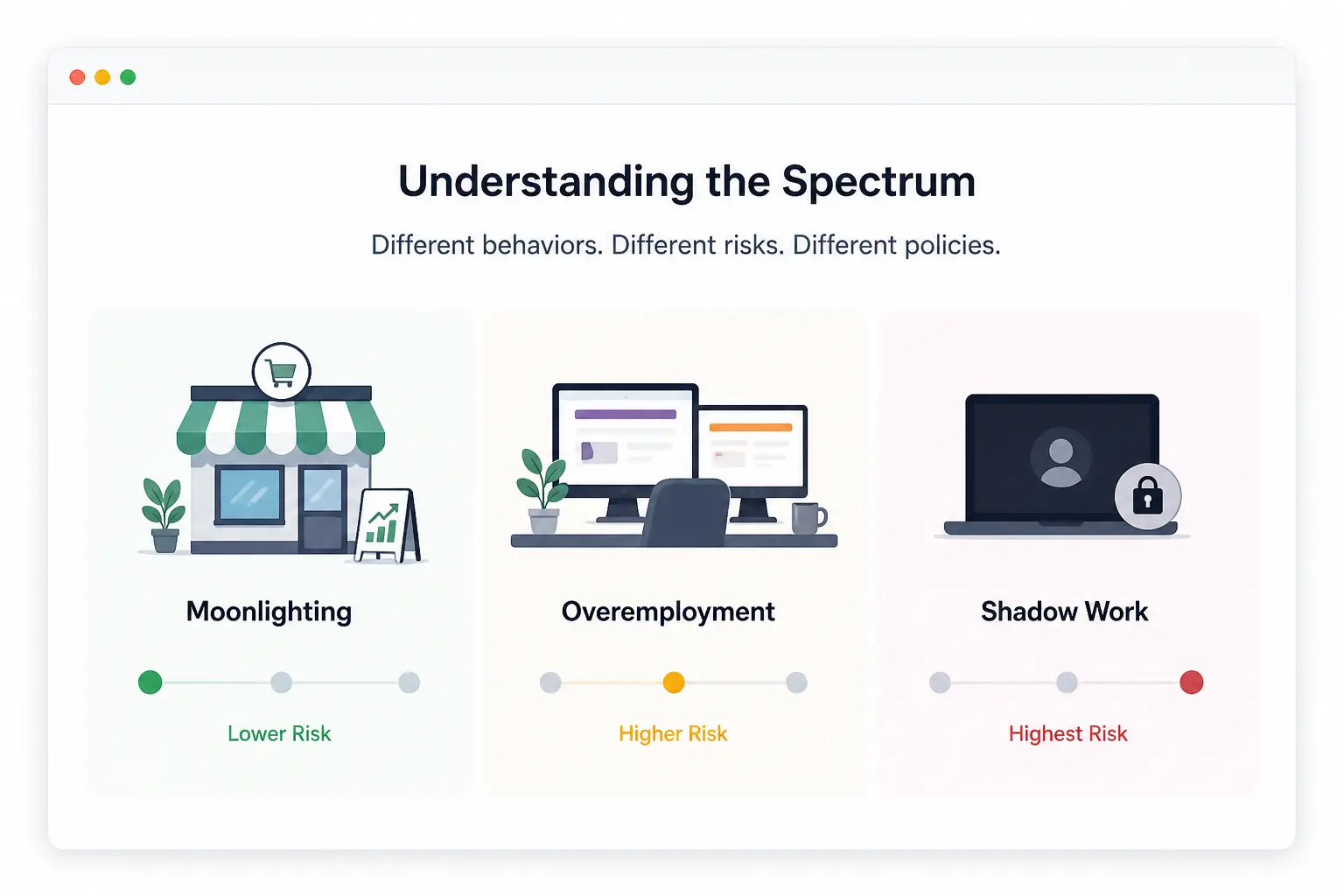
Lumping different behaviors together is where most moonlighting policies go wrong from the start. A weekend freelancer building a side brand and someone secretly working two concurrent forty-hour jobs represent completely different problems. Policies built to address one usually fail at addressing the other — they're either so restrictive they breed resentment, or loose enough that the genuinely risky arrangements slip right through.
Moonlighting is the oldest category here — a second job or side business worked outside primary hours. Historically it was easy to notice because it required showing up somewhere else. Now it doesn't. An employee can hold two jobs from the same desk, attend both employers' video calls, and remain invisible to both unless work patterns give them away. Most moonlighters aren't creating problems. The small fraction who do tend to fall into the more serious categories described below.
Overemployment in Remote Work
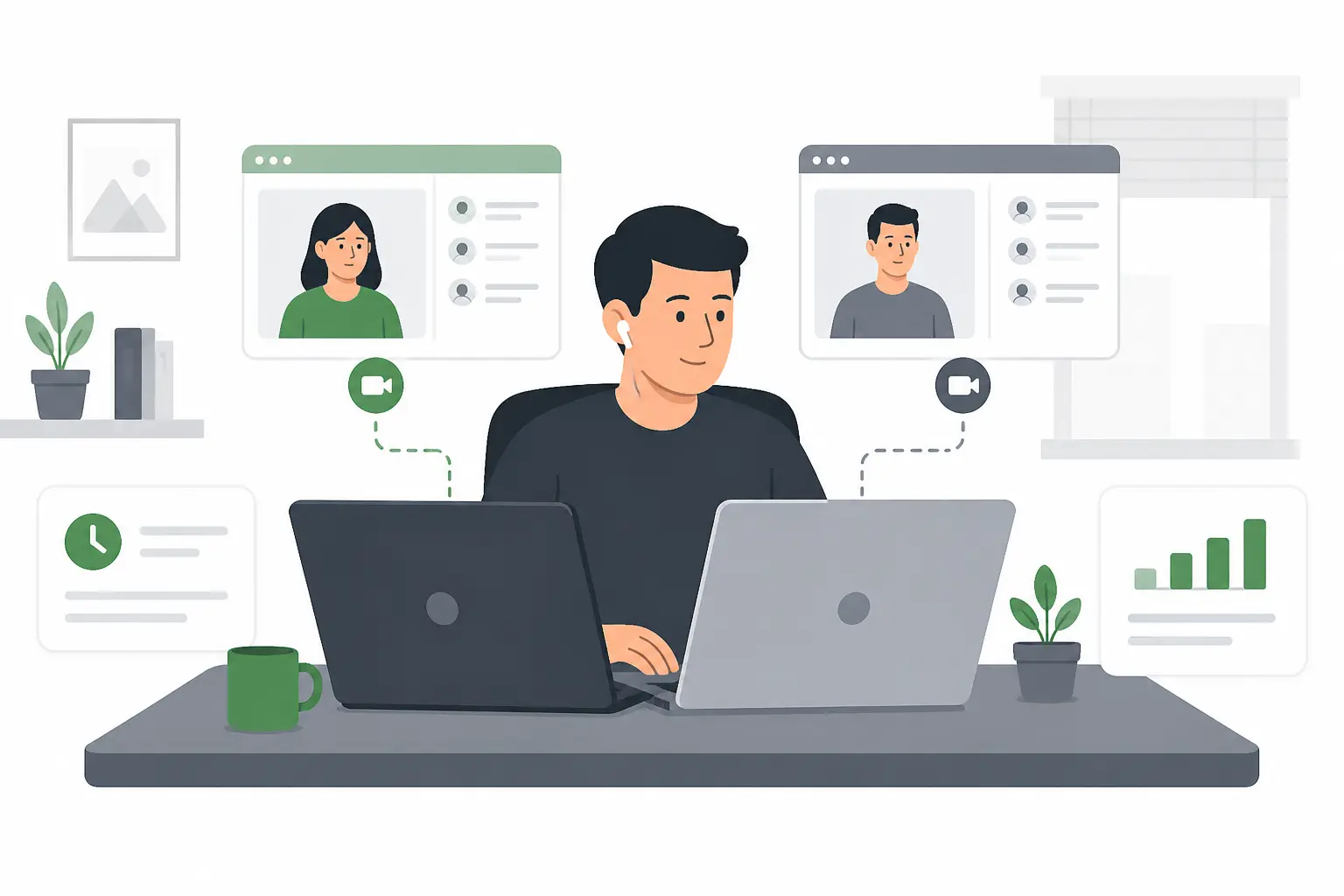
Overemployment is a different animal. It involves two or more full-time roles held simultaneously with overlapping hours — both employers operating under the assumption that they have someone's undivided attention during the same working day. Remote work made this structurally possible in a way that offices never could. You can be logged into two company environments from the same chair, attending back-to-back standups for different organizations, and neither employer would know unless the schedule collisions start producing visible results.
Those results do show up eventually. Missed meetings, slow response times, inconsistent output, divided attention at exactly the moments when deep focus matters most. Add in the conflict of interest exposure and data leakage risk — especially in software, consulting, analytics, and finance, where the work products themselves can migrate between environments with no physical trace — and overemployment moves from a policy curiosity to a genuine operational threat.
Shadow Work
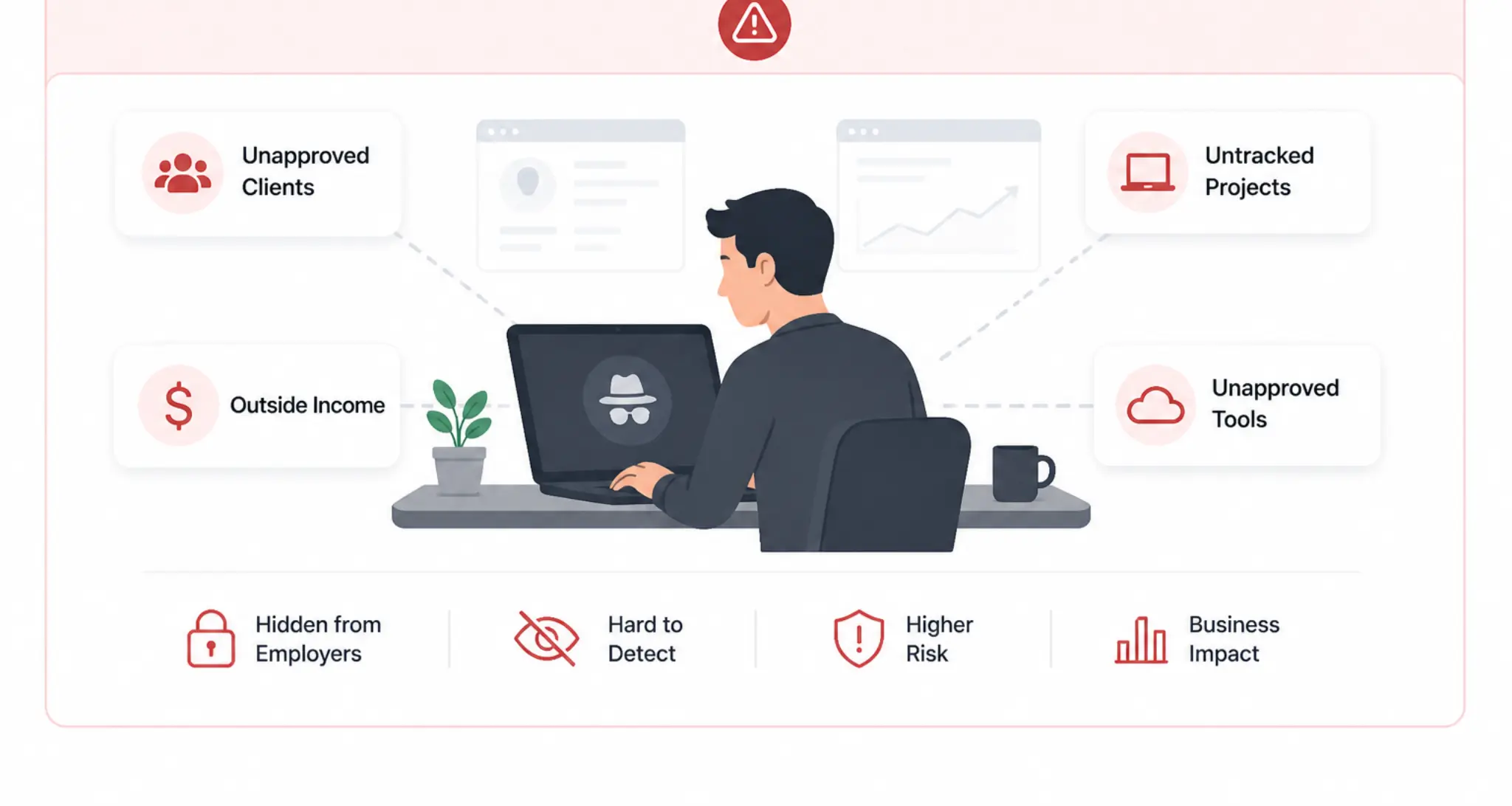
Shadow work is the highest-risk category, and the one most organizations aren't equipped to handle well. It refers specifically to outside work performed during hours an employee is billing their primary employer — not a second job held alongside the first, but paid time being redirected to another client, role, or business entirely. Intent doesn't protect anyone once proprietary code lands in the wrong repository or client context bleeds between accounts. Proprietary methods get used in ways nobody intended.
Signs of Shadow Work in Teams
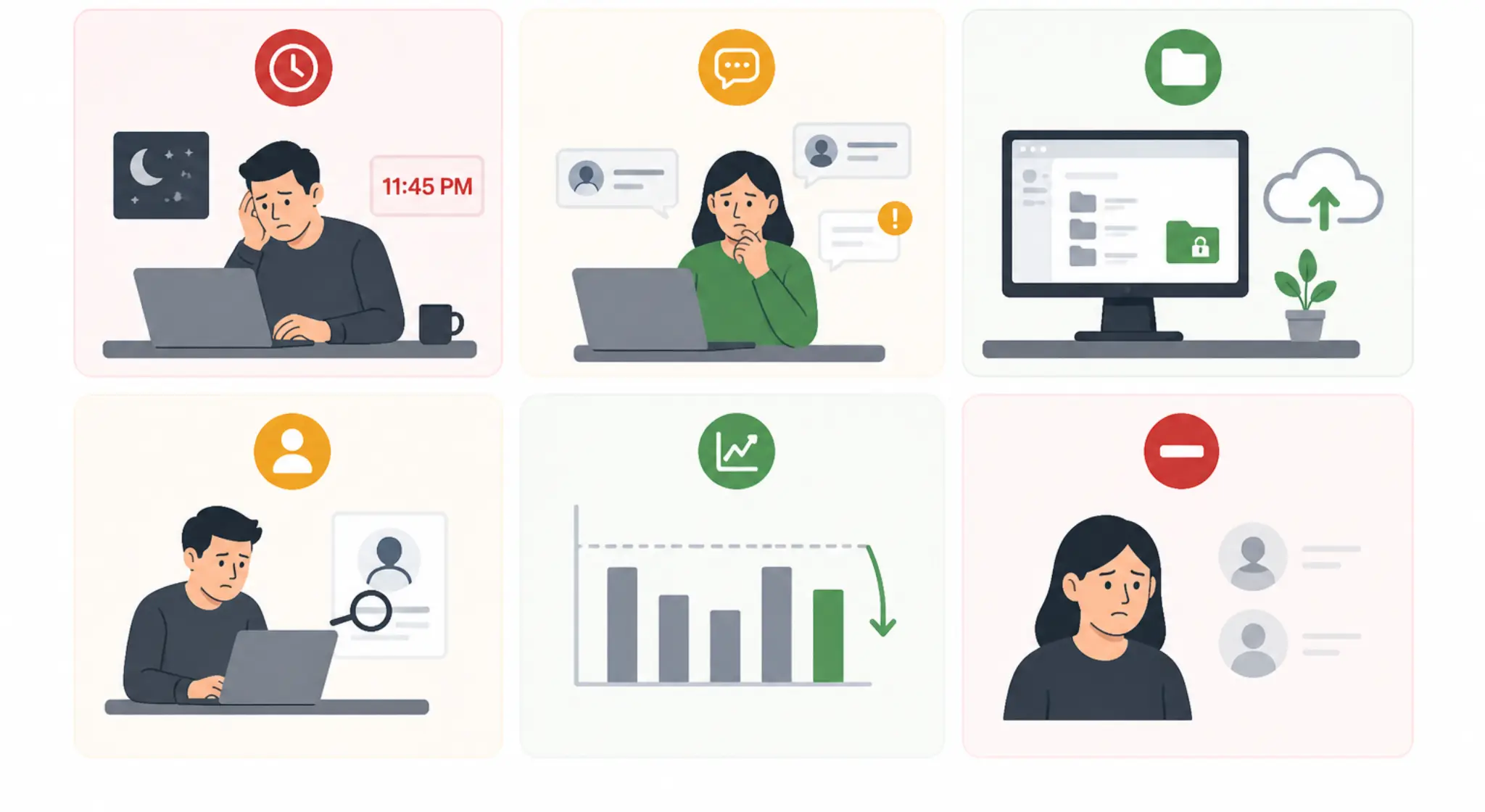
Most managers who've caught this describe the same early experience: they knew something was off before they could explain why. The work still got submitted. The calendar still looked full. But the texture had changed in ways that were hard to name. Deliverables that used to arrive during the workday started coming in at 11pm, or at 6am. The person who used to respond to messages within twenty minutes was now taking half a day — or going quiet entirely. Meeting participation held nominally but the quality of engagement dropped. Small errors started accumulating. Communications got shorter and rougher. Camera-on became camera-off, in calls where that had never been the norm.
Six weeks of that combination is a signal. One bad week is noise. The distinction matters.
Freelance Side Gigs
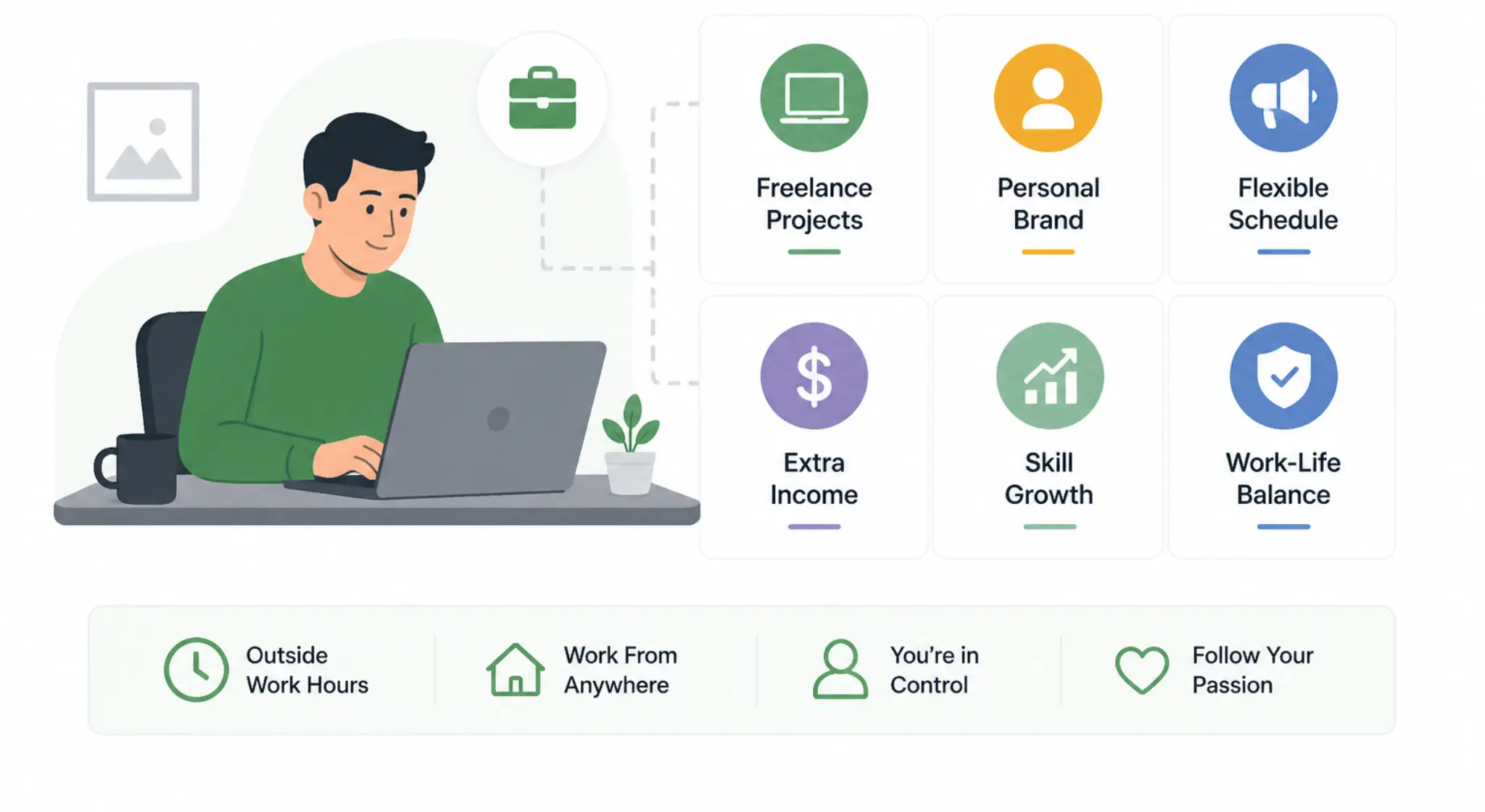
Not all outside work is a problem waiting to happen. A developer building a personal project on weekends, a designer doing occasional illustration commissions — these occupy the low-risk end of a long spectrum. The complication comes when something that started small drifts: a weekend habit becomes a weekday one, the client list starts to overlap with the employer's tools or knowledge that belong to the primary role start serving the side work. Those two scenarios call for different responses, and a policy that doesn't distinguish them will handle both badly.
Legal Groundwork
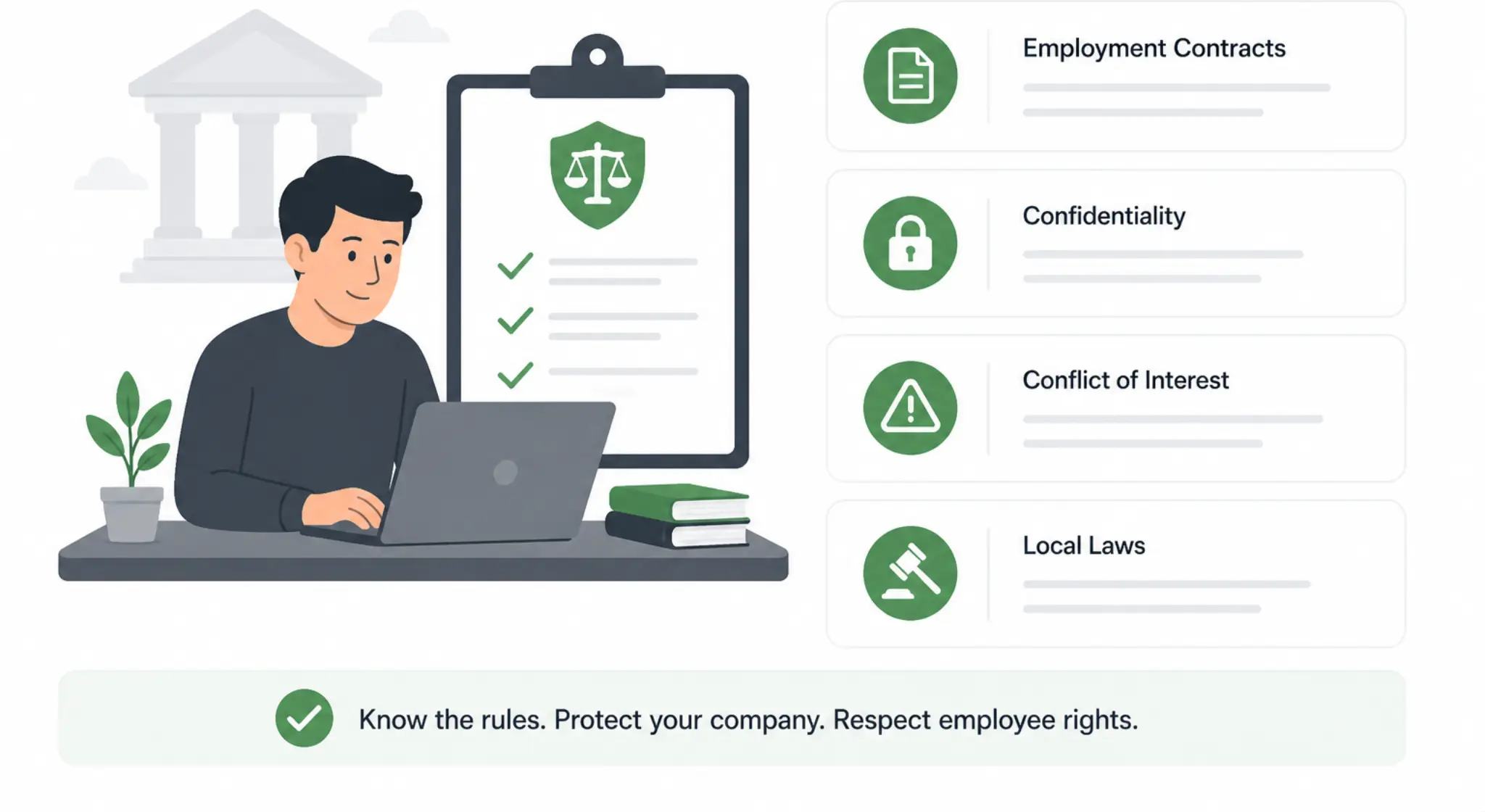
A well-written policy that can't be enforced is just noise. And a policy that tries to control what employees do with their own time will almost certainly fail legally, practically, or both. U.S. employment is mostly at-will, which gives employers real authority to define job expectations — but not authority over off-hours conduct that doesn't affect the employer's legitimate interests. Those interests are real and worth protecting: schedule availability during paid time, protection of confidential information, avoidance of conflicts that compromise the business. Staying inside those boundaries is what makes a policy defensible.
Non-compete restrictions have weakened significantly across many jurisdictions. Even where they technically apply, enforcement is expensive, slow, and unpredictable. Confidentiality agreements and IP assignment clauses hold up better in practice. A clearly written conflict of interest policy that spells out what permitted outside work looks like — and what crosses the line — gives both sides something concrete to work from. Adding explicit language that prohibits using company time, devices, or data for outside work covers the most common exposure without reaching too far into how employees spend their evenings. When outside work is permitted but needs formal parameters, a dual employment agreement creates documentation both parties can point to.
Privacy law and monitoring law sit inside this space too. Some monitoring methods require advance notice and consent depending on jurisdiction. Beyond legality, though, surveillance that goes further than necessary tends to cost more than it recovers — reputational harm, retention problems, cultural damage that outlasts whatever the monitoring was designed to find. The productive question isn't "what's the maximum we're allowed to track?" It's "what's the minimum we actually need to protect what matters?" The organizations that ask the second question tend to defend their approach far more credibly.
Behavioral and Digital Signals
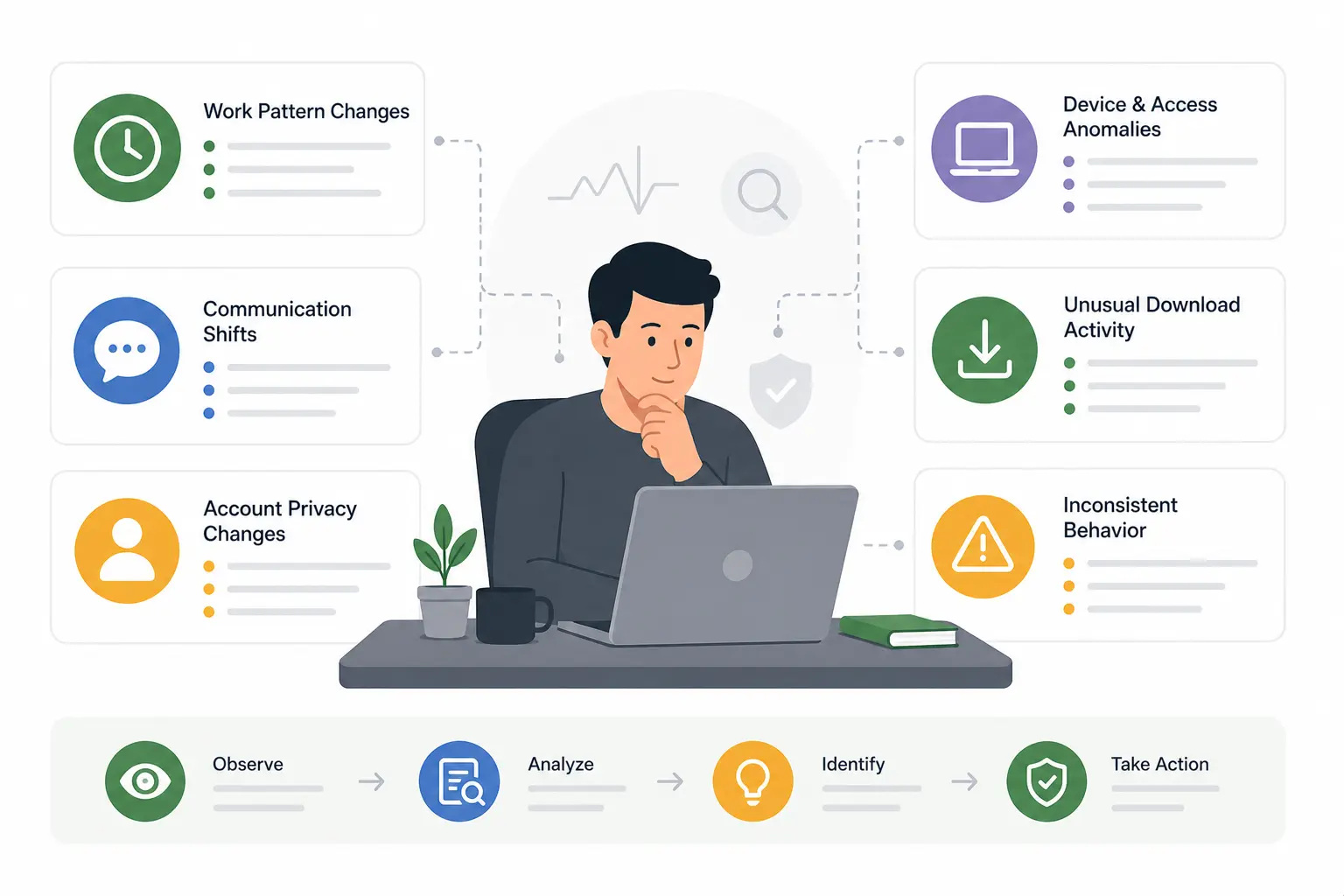
Gathering evidence before having a conversation tends to make things worse, not better. That impulse makes emotional sense, but it's usually what pulls organizations toward overreach. Surveillance creep doesn't start with a deliberate decision to monitor everything — it starts with wanting certainty before having a conversation. By the time you've built a file of screenshots and message logs, you've probably already damaged the trust you were hoping to protect. The sequence that works better: notice the business-impact signal, gather enough pattern context to make the conversation factual rather than accusatory, then have the conversation.
Behavioral signals tend to come first. Someone reliably present during core hours starts showing gaps nobody can explain. Deliveries that used to arrive on time start slipping consistently, without the kind of blocker that would account for it. Video engagement drops off. Responsiveness becomes erratic in a way that doesn't map to any workflow change. None of this is a conclusion — it's the basis for a direct, private conversation where a manager asks what's going on.
Pattern data is useful when it's pointed at the right question. That question isn't "how do I build a case?" It's closer to: does what I'm seeing reflect a real operational problem, or is it noise? That reframing changes what you look for — and it's the difference between using data responsibly and using it as a pretext. Organizations that reach for content capture — screenshots, message logs, keystroke records — create privacy and trust problems faster than they solve anything. Organizations that look at time structure and workload patterns can justify what they're doing as minimally necessary to protect real business interests, and that justification holds up.
How to Detect Overemployment in Remote Workers
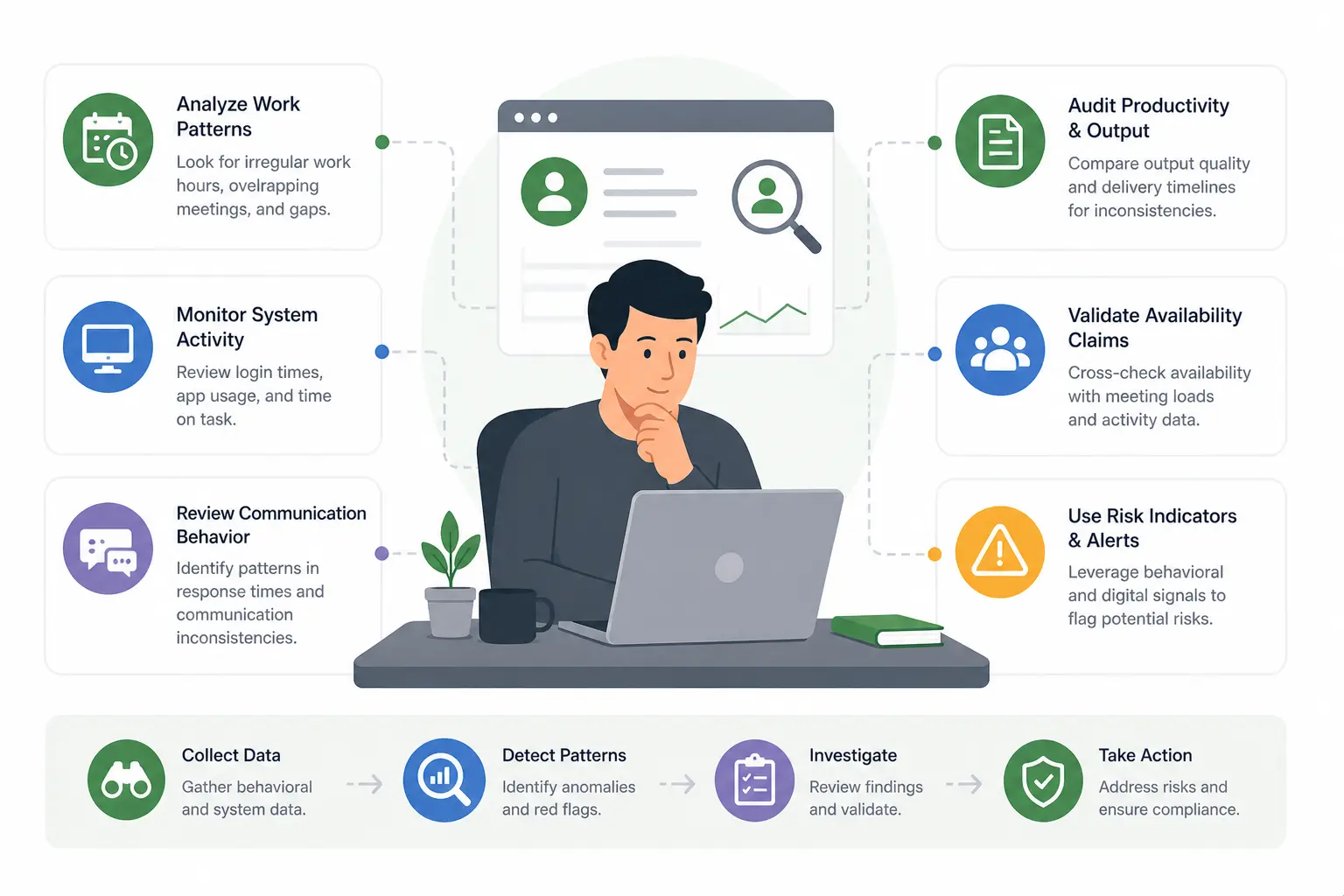
Detecting overemployment in remote workers calls for a different mindset than standard performance management. Part of what makes it tricky is that overemployed employees are often genuinely capable — during quieter periods on both sides, they deliver adequately on both jobs. The situation deteriorates when demands peak on both sides at once, when meetings conflict, or when sustained split attention starts showing up in quality, responsiveness, and reliability.
How to detect overemployment isn't primarily a tools question. It's a pattern-recognition question. There are three categories worth watching — and they only carry weight when they show up consistently over time, not as occasional blips.
Schedule asymmetry is the first thing to look at. Overemployed remote workers tend to structure their days in ways that serve two separate schedules — very early starts, a drop-off mid-morning when one employer's meeting load kicks in, a restart in the early afternoon, an extension into the evening. In a session log, this shows up as split-day activity or compressed active windows that don't fit what the role actually requires. One day like that means nothing. Six weeks of it is a different conversation.
Output inconsistency is the second signal. A disengaged employee tends to be consistently mediocre. An overemployed remote worker swings — highly responsive and ahead of schedule one week, hard to reach and behind everything the next. That swing itself is what you're looking for, because it tracks with when the other employer's demands spike.
Collaboration withdrawal tends to come third. People managing two concurrent full-time roles quietly stop participating in anything that isn't a hard obligation. Team chats go quiet. They skip the optional problem-solving sessions, pull back from mentoring, stop showing up to the things that aren't tracked but matter. You might not notice it in any given week. After two or three months, it becomes a pattern that's hard to ignore.
None of this is proof. All of it is legitimate basis for a direct, private conversation where a manager surfaces what they've observed and asks a question. Usually that conversation is enough.
Responsible Detection: Work Patterns in Controlio
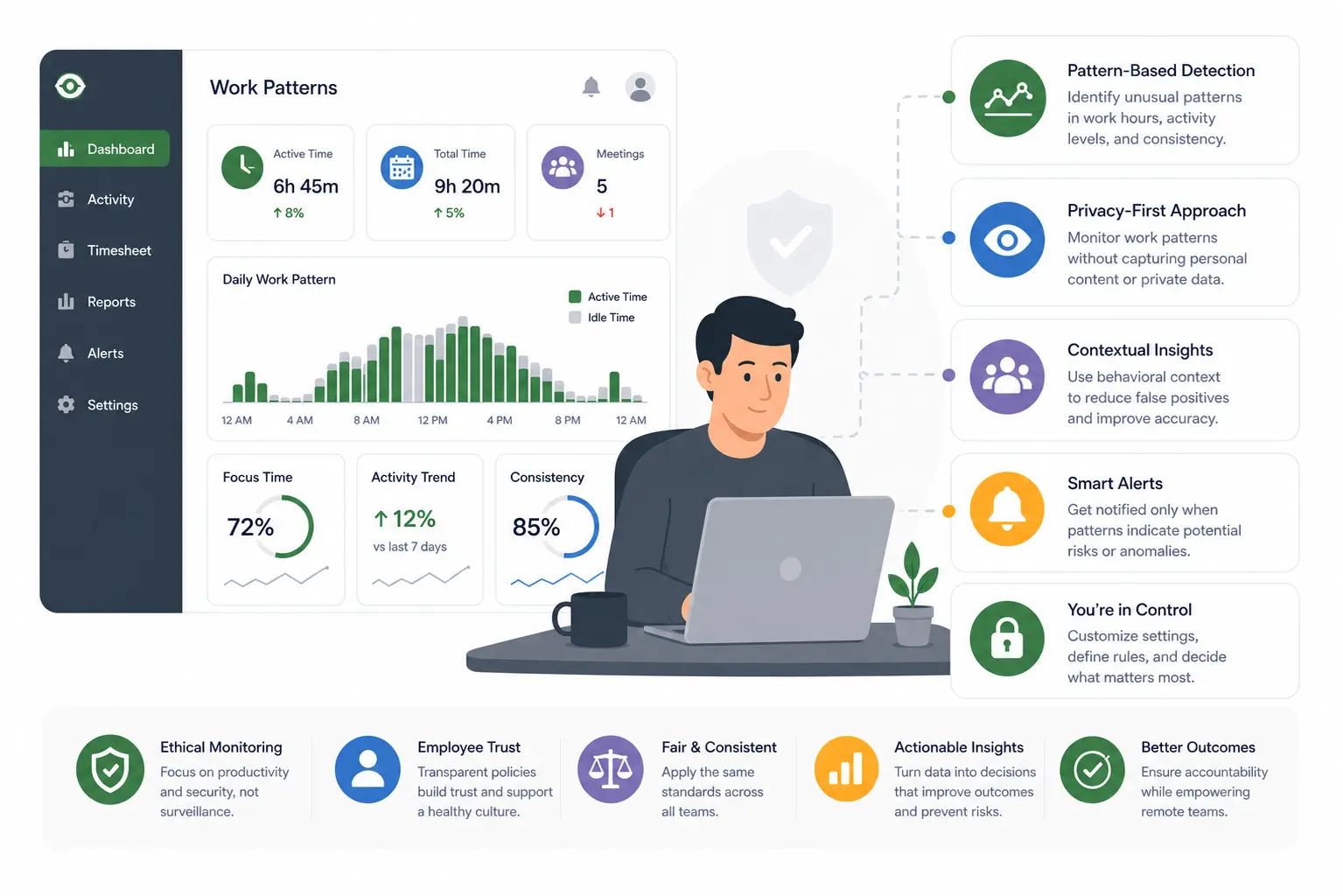
Surfacing moonlighting, overemployment, or shadow work risk doesn't require reading anyone's messages or recording their screens. The most defensible approach is looking at how work is structured over time. Controlio's Sessions, Workload, and Multitasking reports do exactly that — they surface risk signals using employee work patterns and time structure rather than invasive content capture. Leaders can spot unusual shifts, compressed working days, and attention fragmentation patterns without getting anywhere near private content.
Start and End Times of Working Sessions: Sessions Report
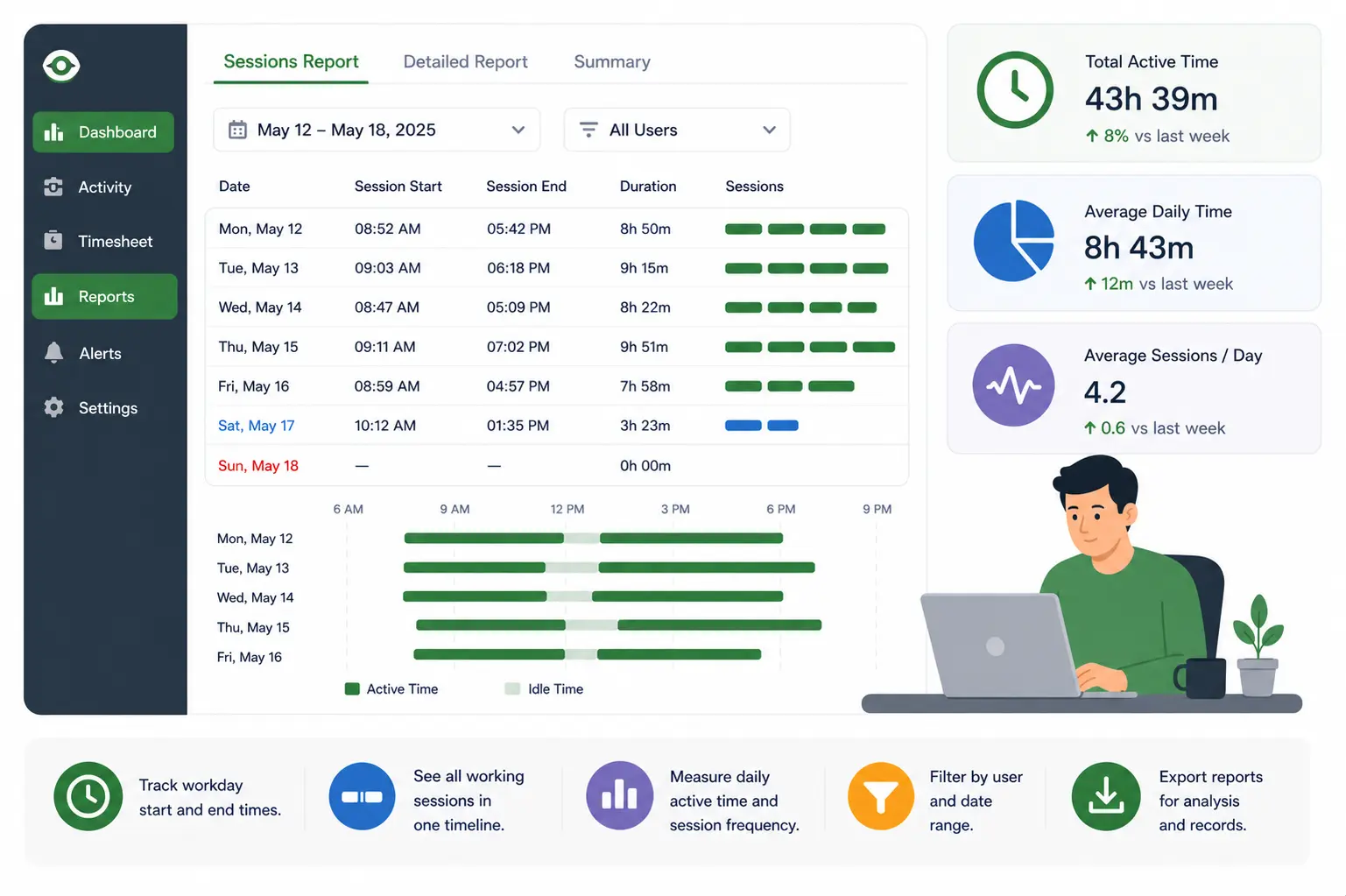
Session timing matters because overemployment leaves a distinctive footprint in how a workday is shaped. In the Sessions report, consistent early starts paired with odd midday gaps, split-day patterns where work resumes late in the evening, or extended spans that stretch across hours that don't fit the role — these are the structures worth examining. A single odd day registers as noise. The same structure across six weeks registers as something to address.
Worth being clear: the Sessions report isn't designed to penalize anyone for working outside standard hours. Some of the most effective people in any organization work unconventional schedules. What it's designed to do is surface patterns that are statistically out of step with the role and the team, so a manager can have a conversation rather than issue an action.
Average Daily Working Hours: Workload Report
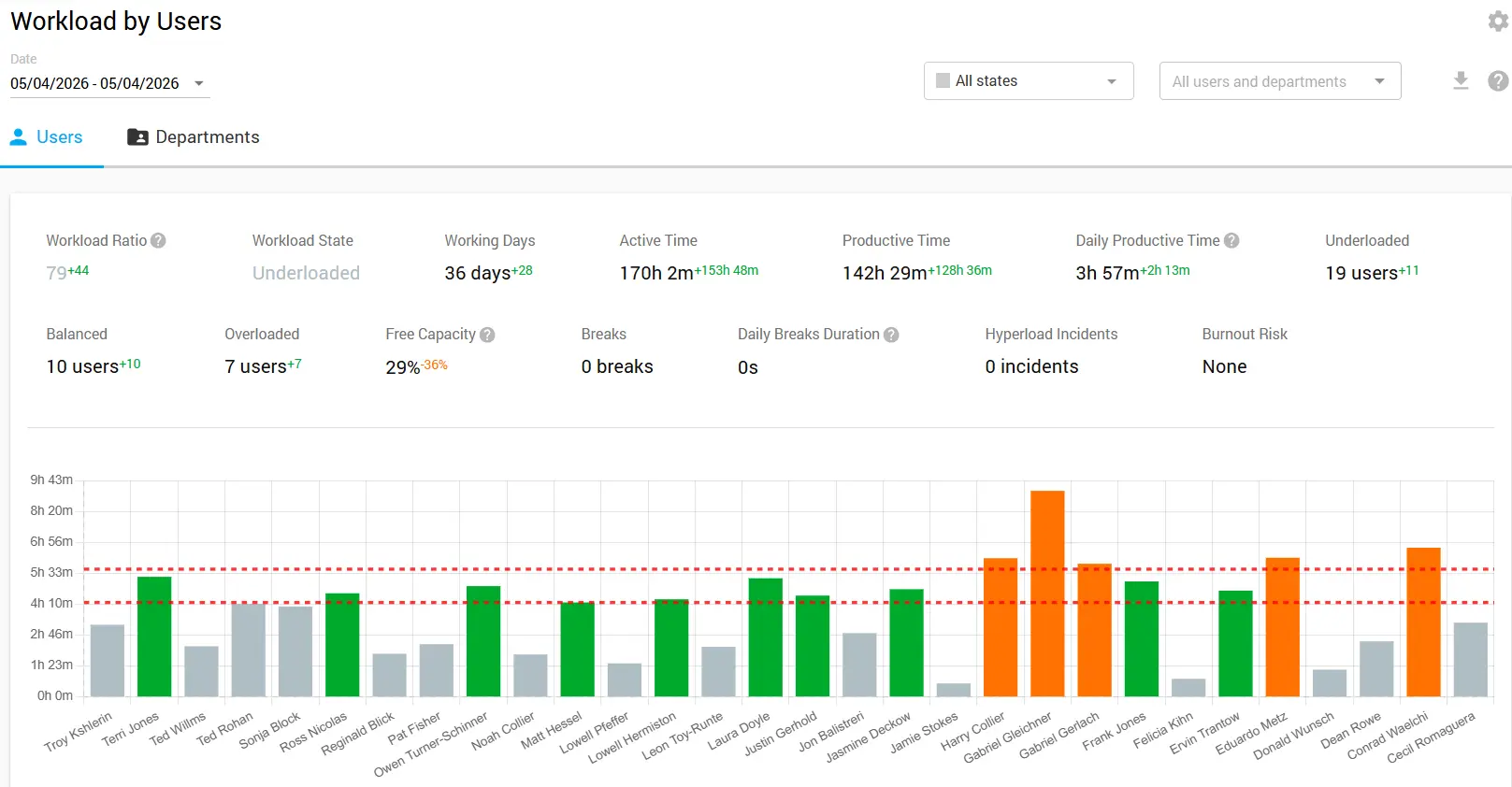
The Workload report shows whether daily output tracks against workload expectations. Overemployment sometimes shows up as persistent under-delivery — hours quietly shrink while responsibilities stay fixed and performance starts sliding. It also shows up as erratic allocation, where output is heavy one day and nearly absent the next, without any workload explanation for the difference.
These patterns aren't proof of anything. They're a lens. If employee work patterns shift and performance follows, that's grounds for a conversation. If patterns are stable and work is solid, the organization should resist reading significance into normal variation.
Focus vs. Multitasking Hours per Day: Multitasking Report
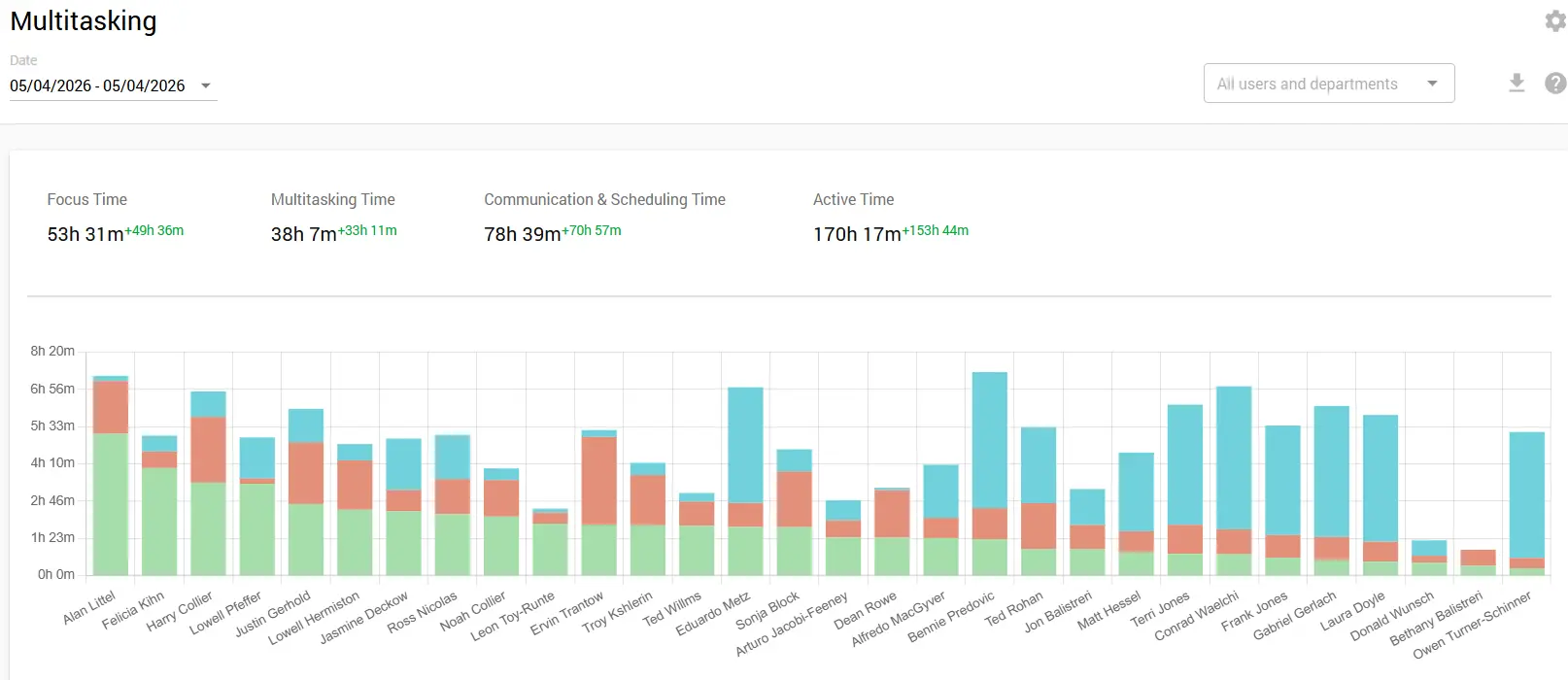
Divided attention is genuinely hard to fake for long. Attention fragmentation in remote teams is one of the more reliable signals of overemployment precisely because sustained focus is difficult to simulate when your attention is split between two employers. Session timing can be adjusted with some effort. Deep work patterns can't be manufactured on demand. Someone fully committed to high-value primary work shows extended focus windows. Someone splitting their attention across two concurrent roles shows fragmented, application-switching patterns that almost never consolidate into the kind of deep work blocks that real primary engagement produces.
Attention fragmentation does have innocent explanations — organizational chaos, too many meetings, role transitions. The signal becomes meaningful when it's new for this person. Not a rough week — a changed pattern. Sustained over weeks, not days. And showing up alongside other things: erratic output, scheduling gaps, declining responsiveness.
Modeling the Cost
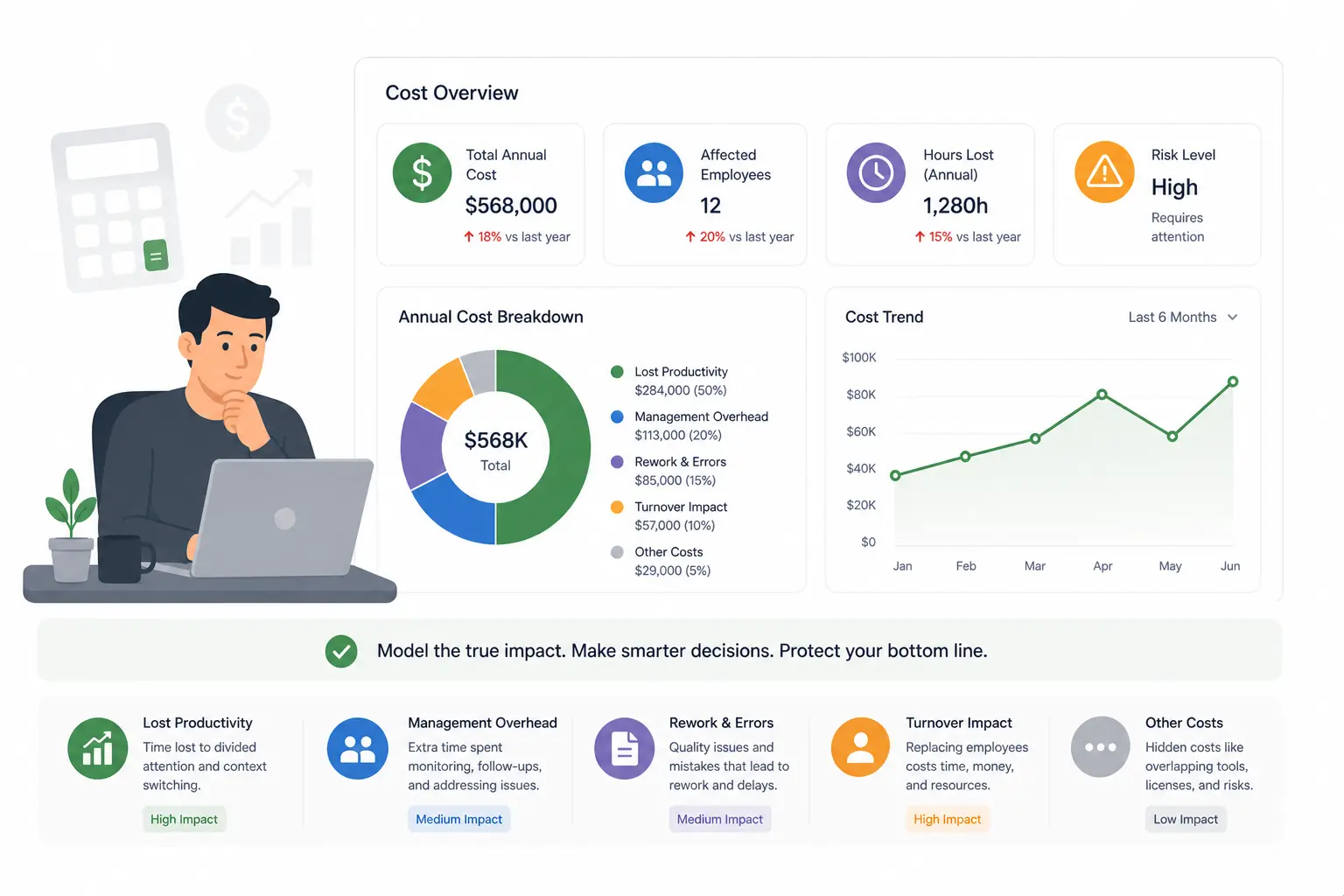
One reason moonlighting doesn't get taken seriously until it's already causing real damage is that the costs spread out rather than announcing themselves. A small performance dip here. A deliverable that's a day late there. Response times that are slightly worse than they used to be. None of it reads as a crisis — which is exactly how it stays invisible long enough to become one. Putting a dollar figure on the impact of moonlighting on employee productivity changes that dynamic. It converts what feels like a vague concern into a business case for proportionate governance.
Focus loss is the most direct measure. An employee splitting meaningful attention across two jobs typically loses somewhere between one and two hours of effective output per working day on their primary role. That loss propagates: errors made under split attention create rework, late deliveries slow dependent teammates, and degraded responsiveness has a compounding effect on team throughput that doesn't show up cleanly on any individual's performance record.
Take someone earning $60 an hour who quietly loses ninety minutes of real output per day. A month of that runs to $1,800 in productivity alone — before any rework, missed deadlines, or downstream slowdowns. Multiply that across ten people in similar roles and you're at $18,000 per month — still before you factor in the tail risk of a security incident. The point of doing that math isn't to build toward punishment. It's to make the case for putting real governance in place before the problem reaches that scale.
The Humane Policy Ladder
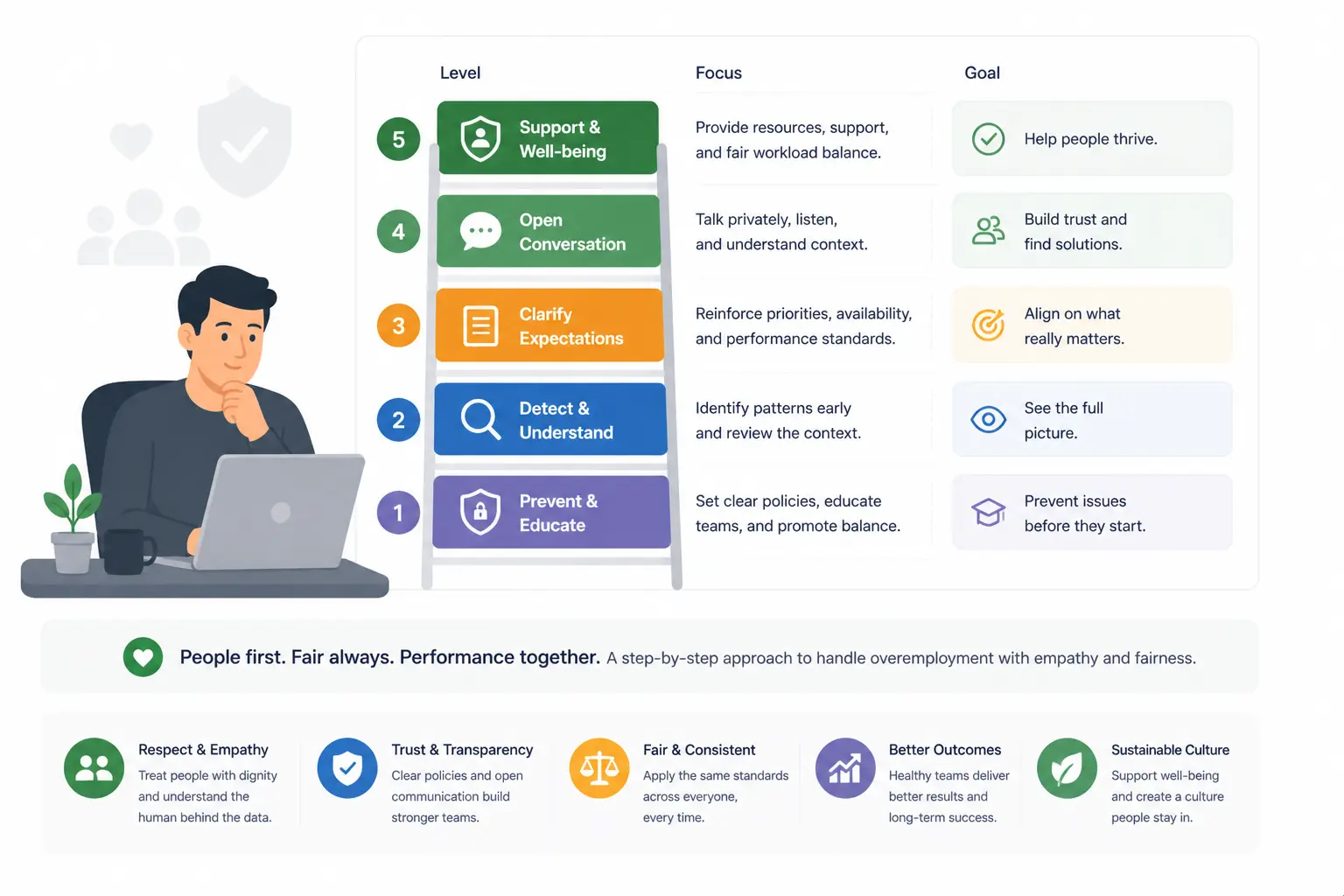
It's a sequence that moves toward transparency first, discipline only when nothing else has worked.
Disclosure comes first. Employees should disclose external paid work through a simple, neutral process — and how that process is framed matters enormously. Disclosure positioned as standard governance under the organization's conflict of interest policy lands very differently than disclosure that feels like the first step toward disciplinary action. When employees expect disclosure to be used against them, they avoid it. When it feels like routine housekeeping that most colleagues also go through, most comply without issue.
A moonlighting policy template makes the process work in practice. Employees who don't know what disclosure leads to will generally avoid it. A process with clear expectations and predictable outcomes changes that. That moonlighting policy template should live in the employee handbook and get redistributed any time the policy changes — not get introduced for the first time when a manager already has concerns.
Workload and schedule review comes next. Once outside work is disclosed, managers assess whether core responsibilities are still being met, whether availability commitments hold, and whether any of that outside work is bleeding into paid hours. If there are concerns, the first move is to state them clearly — not file them. Reaffirm what the working hour expectations actually are. Clarify meeting participation standards. Name the performance outcomes that matter. Most situations that have gotten to this point can be resolved with a direct reset rather than an escalation.
Permitted categories define what's actually fine. Acceptable outside work usually means a different industry, no overlap with the employer's client base, no use of company tools or IP, and strictly off-hours. Writing that out removes a lot of ambiguity — and stops employees from avoiding disclosure because they genuinely can't tell where the line is.
Red lines define what's categorically prohibited regardless of how good an employee's performance is, because some risks are structural and can't be managed case by case. Working for a direct competitor. Consulting in the same industry with overlapping clients. Holding simultaneous full-time roles with conflicting schedules. Using company systems, credentials, data, or devices for outside work. These aren't judgment calls to be made on a situation-by-situation basis — they're fixed prohibitions, and the policy should name them as such.
Demonstrating the Controlio Approach
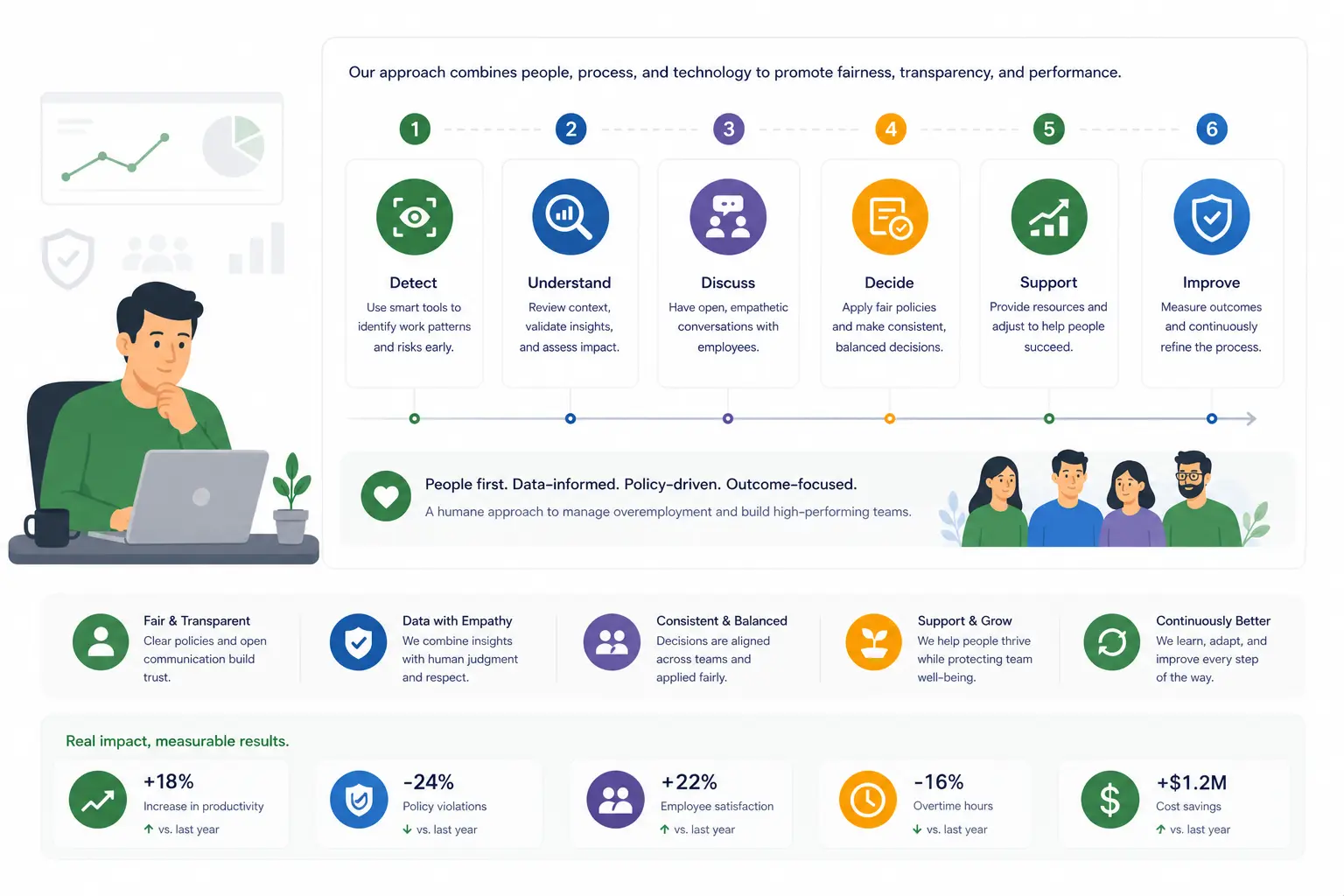
The case this guide makes is that responsible detection is achievable — and that invasive surveillance isn't required to do it responsibly. Controlio's Sessions, Workload, and Multitasking reports allow leaders to surface risk signals through time structure and attention allocation without reading messages, capturing screens, or reviewing content. The practical questions become: Are working sessions showing split patterns that don't match this role? Are daily hours compressed or erratic in ways that correlate with output problems? Is focus time fragmenting into multitasking spikes that line up with scheduling irregularities? Those questions can be answered through employee work patterns, not private content.
Controlio functions as a workforce analytics platform rather than a monitoring tool — and that framing reflects a real operational difference. Workforce analytics connects behavioral signals to operational outcomes: output trends, collaboration patterns, workload distribution. When leaders describe the system to employees, the conversation isn't "we watch what you do." It's: "We use productivity analytics software to understand how work happens at a team level — so we can catch resource problems early, reduce burnout risk, and flag situations that need a management conversation before they become performance problems." That framing is accurate, and it lands far better than the alternative.
This is what responsible non-invasive employee tracking actually looks like. No message capture, no screen recording, no keystroke logs. Just observation of how work time is structured — the same signal a good manager would pick up on if a direct report's calendar suddenly looked completely different from what it used to. Privacy-first employee tracking of this kind is easier to explain openly, easier to justify in legal or HR review, and far less likely to corrode the employment relationship than content-based surveillance. It also produces more operationally useful information. "Are this person's sessions fragmenting into split patterns that don't fit their role?" is a question that leads somewhere. A screenshot archive that no one reviews leads nowhere.
Pattern-based governance keeps leaders disciplined in a way that content capture rarely does. A pattern isn't a case. Using it to start a conversation rather than build a file is what keeps the working relationship intact — and it makes employees more likely to come forward on their own when their situation is genuinely unclear.
Moonlighting Disclosure Form
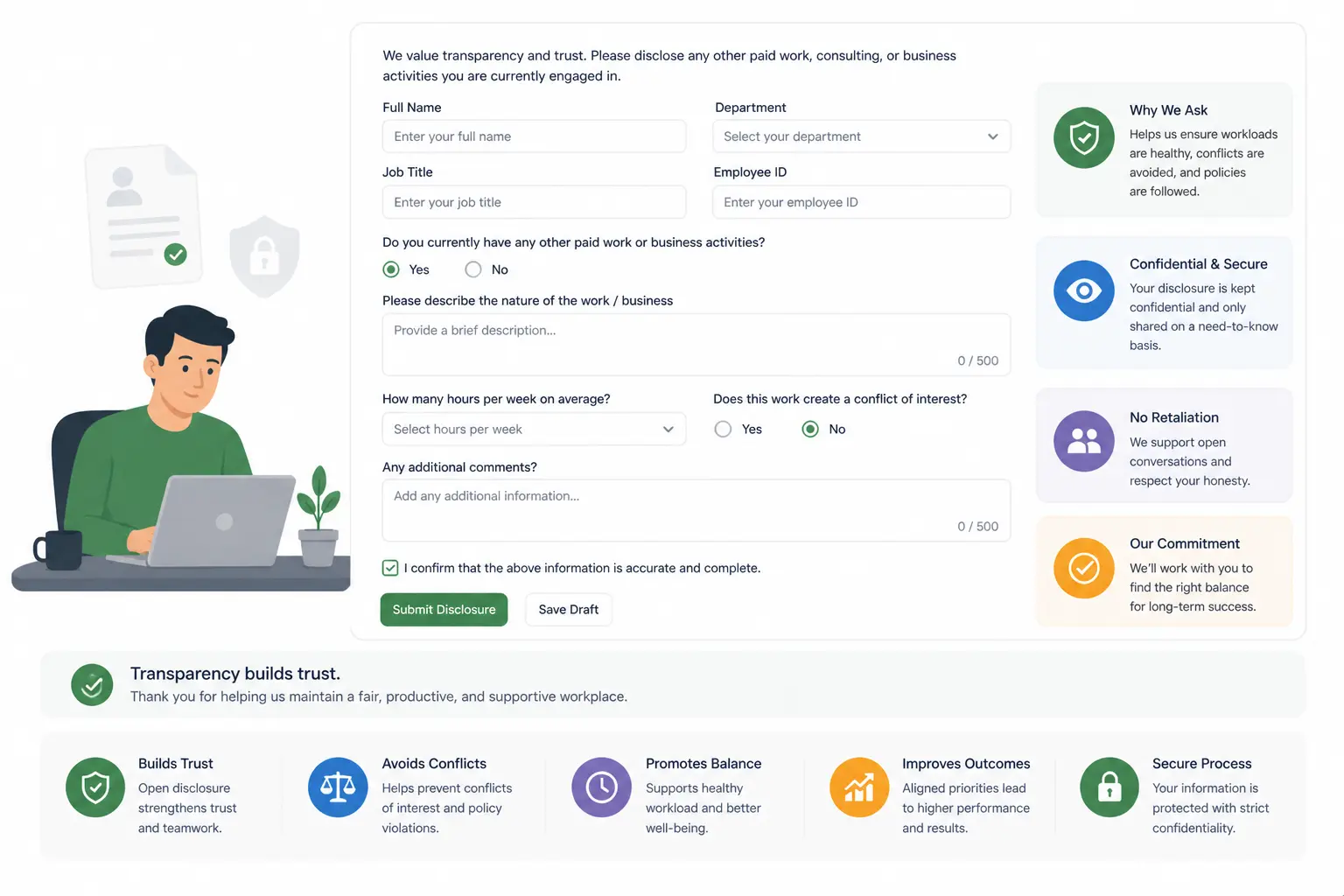
The template below is designed to be adapted to company-specific language. It covers what most organizations need from a disclosure process without adding unnecessary friction.
Conclusion
These arrangements aren't going away. Remote work, economic pressure, and online hiring markets have made multiple income streams more accessible and more normal than they were ten years ago. Organizations that treat this as a temporary compliance blip are going to keep getting surprised by it. The ones that handle it well have generally stopped treating it as aberrant behavior and started treating it as something that needs a framework.
What that framework looks like in practice varies less than you'd expect. The organizations that manage this consistently are the ones where employees know in advance what's acceptable — so they can self-screen rather than guess. Where disclosure feels like standard administrative process, not a career risk. Where managers have enough pattern context to have a real conversation rather than act on a vague sense that something's off. And where monitoring stays scoped to time structure and attention patterns, which is defensible and useful, rather than expanding into content capture, which usually isn't.
Clarity does more work than surveillance. When the rules are plain and applied predictably, leaders can deal with genuine problems without creating new ones. The monitoring footprint that holds up — legally, culturally, in practice — is almost always the smaller one.
Most situations that end up as dual employment problems didn't start as schemes. They started as financial need, or a freelance engagement that grew, or a line that moved gradually and nobody put a boundary on. A policy that gives employees a path toward transparency early catches those situations before they become something that ends careers. Not because it's punitive. Because it gives people somewhere to go.
That's the actual goal: protect what the organization is paying for, without burning down the working relationship that makes the work worth doing.